
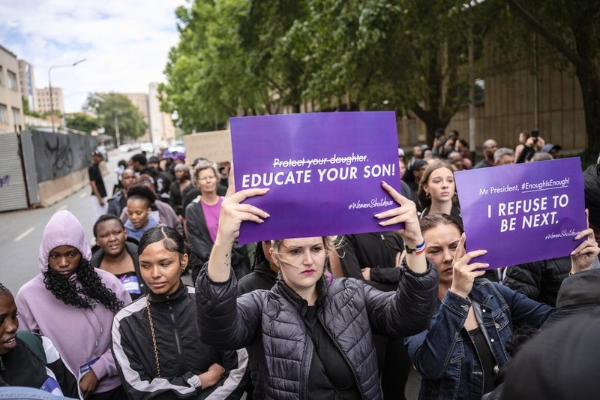
Women gather outside WITS University in Johannesburg from where they walked in a procession with a symbolic casket, honouring the lives of women lost to femicide. Photo: Ihsaan Haffejee, GroundUp.
Gender-based violence and harassment (GBVH) against women in the world of work includes physical and sexual violence. It also includes the abuse of power, economic dependence and the conditions that stop women from speaking out.
When we talk about gender-based violence, we often picture physical assault, sexual violence or open intimidation. These are serious forms of violence, but they do not tell the whole story of women’s experience in the world of work.
Violence also takes less visible forms. A supervisor threatens a woman’s job or holds back her opportunities. A manager links promotion to sex. Colleagues humiliate her. Workers who refuse or speak out are punished.
ILO Convention 190 (C190) defines violence and harassment as behaviour that aims at, or results in, physical, psychological, sexual or economic harm – a job can be used as a weapon.
For a woman on a short-term contract, refusing an advance or reporting harassment can cost her the renewal. A worker who needs overtime work can lose shifts. The question is not whether violence happens at work but who holds power, how they use it, and what a worker can do when it is used against her.
Power as a weapon
GBVH thrives on unequal relationships at work. Hierarchies and economic dependence create openings for abuse and make it hard to challenge.
A supervisor may use control over shifts, performance assessments, promotion or contract renewal to pressure a worker. A manager may make favourable treatment depend on sexual attention. A boss or colleague may use intimidation or humiliation to undermine a woman’s standing.
Some abuse works through favouritism, exclusion, threats to reputation, bad shifts or withheld promotions. The abuser does not have to be the most senior person in the organisation. Anyone who controls something another worker needs, such as income, transport, information or access to opportunities, can use it to apply pressure.
Precarious workers have the least room to push back. When a contract may not be renewed, fear of losing an income keeps workers quiet. LRS participatory action research in garment factories and clothing retail stores shows how often this power is abused. In 2022, SACTWU and SACCAWU worker leaders collected testimonies from 117 workers in three provinces. Of the women surveyed, 98% had experienced at least one incident of GBVH. Managers and colleagues were the main perpetrators.
The price of speaking out
For many workers, reporting violence or harassment means risking the job, the income, working relationships and future opportunities. A worker may fear that no one will take her complaint seriously, that colleagues will turn against her, or that the person responsible will retaliate. When the managers implicated in the abuse also control the reporting system, she has little reason to trust it. Her silence says more about the conditions she works under than about her courage. In the garment and retail research, only 30% of workers reported what happened to them.
A policy may prohibit sexual harassment. But does the worker know how to report? Can she report without going through the person she is complaining about? Will her complaint stay confidential? Is she protected from retaliation? Will she get support without repeating her story to several people?
A policy on paper does not make a workplace safe. Women should not carry the burden of becoming more confident about reporting. Employers must make it possible for workers to raise concerns without losing their livelihoods or facing further harm.
The gap between rights and reality
C190 recognises the right of everyone to a world of work free from violence and harassment, including GBVH. South Africa ratified C190 in November 2021, and it came into force in November 2022. The convention covers violence wherever work happens, including the commute, and calls for an inclusive, integrated and gender-responsive approach to prevention and protection. This approach requires identifying risks, changing harmful practices, setting up reporting channels workers can use, protecting complainants and giving workers access to support and remedies.
Trade unions can bargain for stronger protections, represent workers who experience harassment and challenge retaliation. They can also make sure GBVH is treated as a workplace rights and occupational health and safety issue.
Workplace agreements have not caught up. LRS examined 1,433 agreements in its Agreements Database, covering 26 years. Only one explicitly refers to C190 or gender-based violence. No local agreement defines or prohibits bullying. Collective agreements turn general commitments into rights workers can enforce, which means GBVH must be a demand with specific clauses.
Conditions that allow violence
Prevention starts with how work is organised, which behaviour is tolerated and who holds power.
Employers must identify risks and deal with the conditions that make workers vulnerable. They must examine how recruitment, supervision, promotion, shift allocation, contract renewal and discipline work in practice, and challenge everyday sexism, intimidation and humiliation.
Workers and their representatives must help identify risks and design responses. Reporting systems must be confidential and trusted. Complaints must be handled fairly, and complainants must be protected from retaliation. Survivors should get support without being blamed, pressured or having choices made for them.
Unions must also examine their own structures and make them safe and equal for women.
Punishing perpetrators is part of prevention. The larger task is to change the conditions that allow GBVH.
Beyond 16 Days
The 16 Days of Activism give us a moment to renew commitments and listen to survivors.
Employers must take responsibility for workplace safety. Government must strengthen implementation and enforcement. Unions must make the prevention of violence and harassment part of everyday organising and bargaining.
A woman should not have to choose between her safety and her livelihood. She should not have to endure harassment to keep her job, accept intimidation to get an opportunity or stay silent because speaking out could leave her without an income.
A world of work free from violence and harassment means workplaces where no one can use power to exploit, intimidate or silence workers, and where every worker can earn a living with dignity and safety.
RELATED ARTICLES
GBVH is a power relations issue
Belonging in the trade union