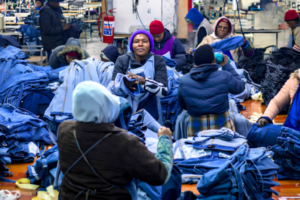

In May 2026, LRS evaluated the Anti-GBVH Programme in garment factories in Lesotho owned by Nien Hsing Textile Co., Ltd. The first blog in our three-part series looked at what it takes to make workplace policies trusted, enforceable and usable in the struggle against Gender Based Violence and Harassment (GBVH). This piece is about power, which is what the policy shifted in Lesotho.
A participant in the supervisors and managers focus group described the years before the programme like this:
“As supervisors, we used to abuse our power. We demanded sex, and if you did not agree, you would not get a job, or your contract would not be renewed. We could also make your life miserable at work and refuse you overtime.”
The quote lists ordinary management decisions: who gets hired, whose contract is renewed, who is put on the overtime roster. Coercion was part of the employment relationship. The quote tells us how routine the abuse had become, and that after the training, a supervisor could look at what he had done and name it as an abuse of power.
Power over hiring, contracts and overtime
Workers described supervisors who influenced floor processes and conditions. Every one of those decisions was a lever over a worker’s income.
“To be hired, you needed to have money or connections. If you did not have any of this, you were expected to sleep with the supervisor.”
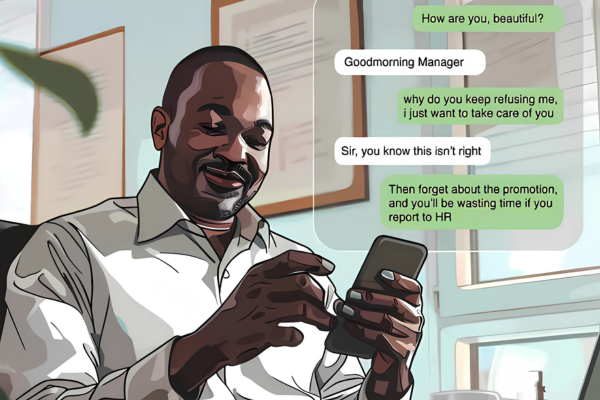
Sexual coercion was therefore tied to the basic question of survival. Harassment violated dignity and bodily autonomy, and it worked as a form of economic control.
Insecure employment made those levers stronger. Workers on daily and short-term contracts could be punished for refusing sexual demands, questioning abuse or asserting a right. The punishment never had to be announced because a contract could simply not be renewed.
Workers did not trust the existing formal rules against sexual harassment, could not easily access them and had never seen them enforced. In practice, a supervisor’s everyday power mattered more than the policy on the wall.
Workers spoke about depression, shame, isolation, unplanned pregnancies and fear. Some withdrew and preferred to be alone, and some organised their working day around avoiding a particular person on the floor.
The harm travelled into households, income security, relationships and workers’ confidence to demand better conditions. When women workers face coercion and retaliation, their bargaining power weakens, and gender inequality is reinforced inside the factory and beyond it.
This is what we mean when they say GBVH is a union issue. GBVH is shaped by the way work is organised, and it influences what workers are able to demand.
“We no longer have absolute power.”
Supervisor
Supervisors described adjusting to a workplace where their authority could be questioned. One reflected:
“I felt ashamed as a person after learning that what we considered jokes were violations. I immediately stopped such behaviour because Watch (Workers’ Rights Watch) was very strict, dealt with cases quickly, and conducted detailed investigations.”
Shame comes first in that sentence, but the reason the behaviour actually stopped comes second: an independent body investigated quickly and thoroughly.
Workers made the same point from the other side. Once they knew they could report misconduct to an independent mechanism, and that a complaint could lead to investigation and discipline, supervisors could no longer assume their authority would go unquestioned.
The power shifted because the structure around it changed. Training helped supervisors recognise their own behaviour, and consequences made them stop.
Making GBVH a bargaining issue
South Africa ratified ILO Convention 190 in November 2021 and it came into force in November 2022. The question is how to make it work in workplaces.
LRS analysed 1,433 collective bargaining agreements on our Agreements Database, spanning 26 years. Only one agreement in the sample references ILO Convention 190 or gender-based violence. None defines or prohibits bullying, and where agreements use the word victimisation, they mean retaliation against union members rather than protection for survivors.
When GBVH is left to employer discretion, the employer decides how complaints are investigated, who is protected, how perpetrators are disciplined and whether survivors are supported or pushed out.
That is the contrast Lesotho offers. The Anti-GBVH Programme did not rely on the employer’s goodwill. Binding agreements created obligations for the supplier and the brands, an independent body handled investigations and determinations, and an oversight committee of unions, women’s rights organisations and brands watched over implementation. Supervisors lost absolute power because someone outside the company could hold them to account.
Unions in South Africa have possible GBVH demands, including: C190-aligned definitions, joint GBVH committees, survivor-centred reporting and investigation procedures, domestic violence leave, anti-retaliation protection, third-party violence provisions and annual gender power audits.
We have the precedent of how an issue becomes a labour relations issue: In the early 2000s. In the early 2000s workers forced HIV/AIDS onto bargaining agendas, and 136 collective agreements now carry concrete HIV/AIDS clauses. An issue becomes a labour relations issue when workers organise to make it one. If GBVH is rooted in power, then the response has to be rooted in worker power.
In this series:
What makes a workplace policy real?
Essential resources: