
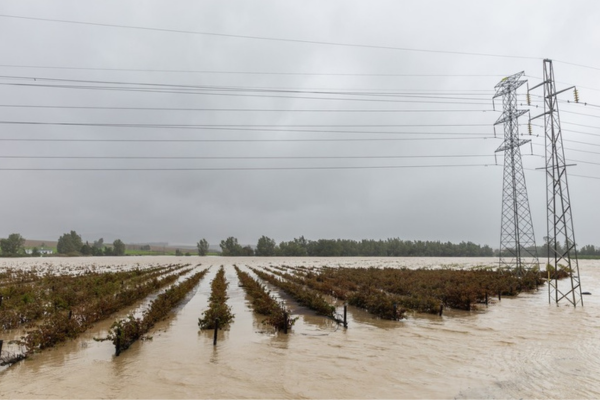
Photo: Flooded vineyard in Western Cape in May 2026 – Ashraf Hendricks, GroundUp
This briefing note draws on the agriculture value chain research paper for the Sector Jobs Resilience Plans published by Trade and Industrial Policy Strategies.
Climate change is expected to intensify existing vulnerabilities among South Africa’s farmworkers, a group already characterised by low wages, seasonal employment, weak access to social protection, relatively low formal education, and limited opportunities for formal training. Agriculture employed approximately 950 000 workers in mid-2026. Around 30% of agricultural employees were employed on a temporary basis, compared with 16% of workers in other formal sectors. Around 75% of farmworkers are employed in elementary occupations, compared with 18% of workers in the rest of the formal economy.
These characteristics make farmworkers particularly vulnerable to climate-related disruptions. More frequent droughts, floods and extreme heat events are likely to increase income volatility and result in farm closures and job losses. At the same time, climate adaptation measures, including mechanisation, automation and precision agriculture, are changing skills requirements and may reduce opportunities for less qualified workers.
Existing Active Labour Market Policies (ALMPs) provide important short-term support but are not designed to deal with climate-related labour market shocks in agriculture. The system is fragmented across multiple institutions and programmes, with no dedicated mechanism to ensure a coherent response to climate shocks, particularly in agriculture. Public employment programmes and employment services provide important short-term support for full-time workers, but often exclude seasonal employees. Moreover, the evidence suggests that they have limited long-term employment effects. Only about 25% of beneficiaries secure any form of employment within six months of leaving a programme, while approximately 8% enter wage employment one to two years later. In practice, these programmes function primarily as temporary income support rather than as instruments to help displaced workers find new livelihoods.
Given escalating climate-related shocks, South Africa needs to strengthen income stabilisation mechanisms for affected farmworkers. Government will therefore have to consider a climate responsive income support mechanism that can be activated following severe climatic events. As the COVID-19 Temporary Employer/Employee Relief Scheme showed, such a mechanism could provide temporary earnings support while enabling workers to remain attached to the labour market and participate in job-search, retraining or redeployment initiatives. Extending coverage to seasonal and temporary farmworkers should be a priority, given their heightened exposure to climate-related employment risks.
Dr Michael Hector is an economist at Trade and Industrial Policy Strategies. View the original article.
RELATED ARTICLES
The meaning of ‘Climate Change’, ‘COP28’, and ‘Just Transition’
A feminist perspective on just transition