
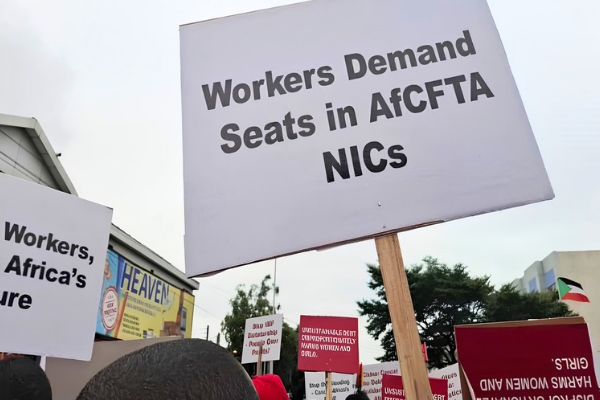
In September 2026, representatives of ITUC-Africa affiliates from South Africa, Namibia, Zambia, Kenya, Ghana, Rwanda and Chad met in Nairobi to launch Phase II of the Trade Unions, Trade and AfCFTA project, themed “Trade Unions in Africa Advancing an Equitable AfCFTA.” National Implementation Committees (NICs) came up often. Participants asked: “How do we ensure that labour is meaningfully and institutionally represented in NICs and other national trade structures?”
In 2025 we published a guide on how to participate in AfCFTA National Implementation Committees. That piece was about getting in. This one is about having influence in NICs.
AfCFTA implementation
Fifty countries have ratified the AfCFTA Agreement. The Agreement is implemented by countries through NICs. As of June 2026, 22 adopted tariff schedules were still waiting to be gazetted. By the same date, 12,126 certificates of origin had been issued, but only 11 State Parties accounted for them.
The tariff rules were written in 2017 and 2018, under different global market conditions. The 39th Ordinary Session of the African Union Assembly adopted the agreed Rules of Origin and directed the Council of Ministers to consider a review of the tariff rules. The direction is towards removing customs duties completely on qualifying goods traded under the AfCFTA.
47 countries and six regional economic communities have adopted AfCFTA implementation strategies. Each strategy sets national priorities, with NICs coordinating processes. According to the AfCFTA Secretariat, 26 State Parties have set up NICs by government decision or decree, and 11 use existing structures. There is no information on NIC status for 12 State Parties.
Million Habte, Coordinator for AfCFTA Implementation at the AfCFTA Secretariat, told the Nairobi meeting that this was the first time the Secretariat had engaged trade unions as a stakeholder group. He described labour as a large stakeholder, and proposed structured consultation between the Secretariat and ITUC-Africa.
The AfCFTA’s legal instruments commit governments to “inclusive and sustainable development.” Trade unions use these texts as a lever. When governments prioritise capital interests over workers’ rights, we will hold them to their own legal commitments.

Trade Unions in Africa Advancing Equitable AfCFTA: Inception and Regional Coordination Meetings of the AfCFTA Trade Union Engagement Project for 2026–2029 | September 2026, Nairobi
Where NIC decisions are made
NICs look different from country to country because trade environments, resources and systems vary. The core structure has three levels:
- A high-level steering committee, led by the president, prime minister or trade minister, oversees the country’s national AfCFTA implementation strategy.
- A national secretariat coordinates domestic ministries, the private sector and the continental AfCFTA Secretariat.
- Technical working groups focus on specialised areas of the Agreement, for example rules of origin, customs procedures, trade in goods and services, and non-tariff barriers.
Trade unions should sit at the steering committee level and in the working groups.
The Trade Union Centre of Workers of Rwanda (CESTRAR), the Trades Union Congress Ghana, the Nigeria Labour Congress and the Trade Union Congress of Namibia (TUCNA) sit on their countries’ NICs. TUCNA General Secretary Mahongora Kavihuha described the union’s campaign for inclusion in detail.
These unions won their seats by making themselves visible on trade and being proactive. At a panel in Nairobi, unions from Namibia, Kenya, Chad and Rwanda showed that engagement is progressing differently across countries. Many unions are still working to have representation on NICs. Where political will is lacking, unions are using various strategies, including:
- Consistent participation in trade debates makes excluding unions a political liability for government. Trade unions are developing advanced technical and institutional capacities to engage complex trade and investment processes.
- Empirical evidence. Research supports high-level policy influence, negotiation capacity and strategic communication.
- At the workplace, build workers’ understanding of the AfCFTA and its impact on jobs and rights. In public, raise the visibility of the union agenda on the AfCFTA, industrialisation and decent work, and strengthen alliances and accountability.
- Through joint campaigns, communiqués and advocacy initiatives.
Influence, or placeholders?
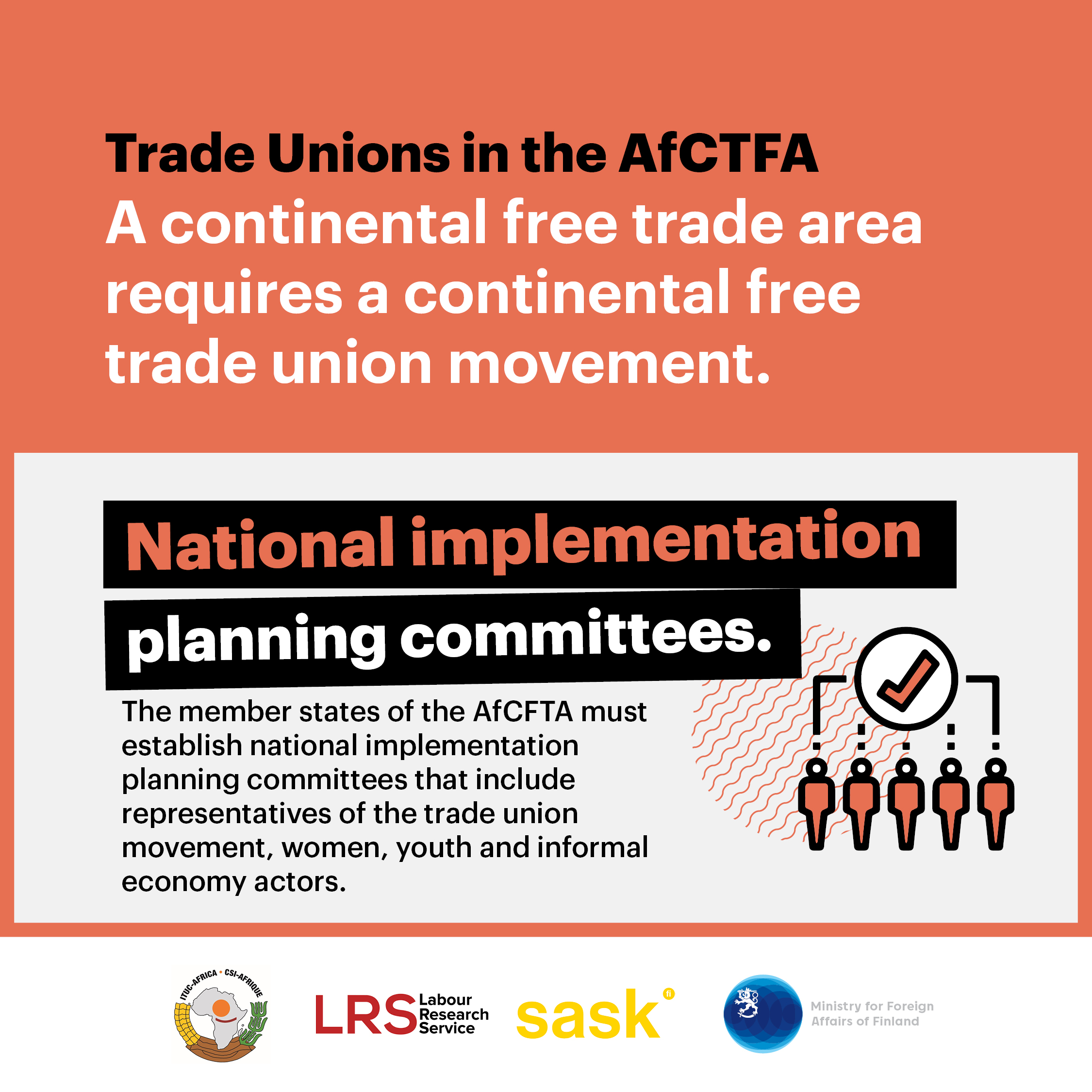
Unions demand that AfCFTA member states establish national implementation planning committees that include trade unions, women, youth and informal economy actors.
Getting a seat is the first step. Comrade Mahongora calls what comes next a test for unions negotiating international trade:
“Now that we have secured a place in the National Implementation Committee, we are asking the question: Will we use the space to influence, or will we become placeholders?”
– Mahongora Kavihuha, General Secretary, TUCNA
He says unions were excluded from the early phases of the AfCFTA and are now trying to “catch the train” and prepare to engage meaningfully.
In the Nairobi meeting, Ghana TUC named effective participation in its NIC as its top priority. Getting there takes what Mahongora calls serious capacity building across the sectors unions organise.
Panellists also described the frustrations of holding a seat. NIC meetings rarely happen, and unions struggle to get documentation.
Women face extreme challenges in cross-border trade. A report by the African Labour Research and Education Institute on the experiences of traders and transport operators in West and East African border corridors highlights unpredictable procedures and payments, limited facilities, weak protection and low AfCFTA awareness among many traders.
Trade unions demand a simplified trade regime for women and youth in informal cross-border trade. The union approach is to organise, protect and represent.
The AfCFTA Secretariat is drafting a regulation under the Protocol on Women and Youth in Trade that would simplify procedures for small traders with consignments of up to USD 5,000. Unions will use their influence in NICs and other social dialogue structures to make sure that regulation is adopted and implemented.
From seat to influence
The six practices below draw on trade union experience and on lessons from social dialogue bodies elsewhere.
- Have a written mandate before each NIC meeting. In South Africa, business and labour in the National Economic Development and Labour Council (NEDLAC) must confirm that their members have authorised proposals.
- Sit where the drafting happens. NICs do much of their detailed work in technical working groups. Ghana’s NIC had seven in 2023, each covering one trade cluster. Find out which working group covers the sectors you organise, and ask for representation. Ask to be on the circulation list for draft papers. Where meetings rarely happen, ask for a published meeting calendar. Unions in Cameroon are demanding formal seats on technical subcommittees and guaranteed access to NIC working documents.
- Put labour’s position on the record. Send written inputs, and ask for labour’s position to be documented. At NEDLAC, the standard operating procedure for reviewing draft legislation ensures that the social partners have their views officially documented.
- Bring evidence to the NIC. Ask what your NIC measures. Two new AfCFTA Secretariat tools will shape this: the Operational Capacity Assessment Tool (OCAT), which assesses each NIC across eight dimensions, and the Monitoring, Evaluation, Reporting and Implementation Tracking (MERIT) tool, which will standardise how countries report on implementation. If jobs are not on the list, push to include jobs created and lost, trends in informality and outcomes for women. Use the AfCFTA’s own non-tariff barrier reporting system. Businesses of every size, including informal traders, can report barriers to trade in goods. By mid-2025, traders had logged 220 complaints, and more than half were resolved, taking 39 days on average. Unions can help informal traders file complaints, then follow them up in the NIC.
- Work beyond the trade ministry. TUCNA found that Namibia’s Ministry of Labour didn’t see itself as part of the trade policy process. TUCNA now works with the ministries of labour, trade and finance. CESTRAR sent its NIC application to the Ministry of Trade and copied the Minister of Labour. At the annual labour compliance panel with the trade minister, CESTRAR demanded to know how many jobs trade and investment create. The union is represented on Rwanda’s NIC.
- Don’t rely on the NIC alone. The NIC is one channel. Nationally, unions can also use Parliament, budgets and the Implementation Review Mechanism (AfIRM) review. Regionally, they can use the committees of regional economic communities and regional parliaments. At continental level, they can engage the Secretariat, protocol negotiations and the Pan-African Parliament.
The AfCFTA texts offer openings too. The Protocol on Industrial Policy and Development is still to be negotiated, and unions can propose concrete text. The Investment Protocol already has labour provisions unions can use. Article 33 requires investors to comply with ILO standards and bans child and forced labour. Articles 28, 29 and 31 cover employment, skills and states’ duty to protect labour rights.
Unions elsewhere have shown how this works. Under the EU–Korea trade agreement, the Korean Confederation of Trade Unions (KCTU) filed an ILO complaint, raised labour rights in the agreement’s civil society forum, and worked with the ITUC and ETUC. Pressure from European unions, after a 2017 European Parliament resolution, helped push the EU to open a formal dispute in 2018.
RELATED ARTICLES
- How to particpate in AfCFTA National Implementation Committees
- How workers’ voice is shaping AfCFTA processes
- How trade unions in Namibia secured a seat on the AfCFTA national implementation committee
- How trade unions in Rwanda secured a seat on the AfCFTA national implementation committee
ESSENTIAL RESOURCES