

The African Continental Free Trade Area (AfCFTA) National Implementation Committees facilitate the effective and coordinated implementation of the free trade agreement in countries. The National Implementation Committees are a formal social dialogue mechanism established through the binding treaty, and a strategic entry point for trade unions campaigning for an inclusive AfCFTA.
The Trade Union Centre of Workers of Rwanda (CESTRAR) is part of the National Implementation Committee as of September 2025. I want to share CESTRAR’s experience to inspire unions across Africa agitating for inclusion.
Trade and investment issues have gained prominence in union strategies after being sidelined historically. I acknowledge ITUC-Africa and Labour Research Service for highlighting international trade to CESTRAR and the commitment to developing union competency in trade issues. We see the possibilities of the AfCFTA for workers, particularly women and youth in trade. We also see the risks and the complete absence of labour provisions in the continental agreement.
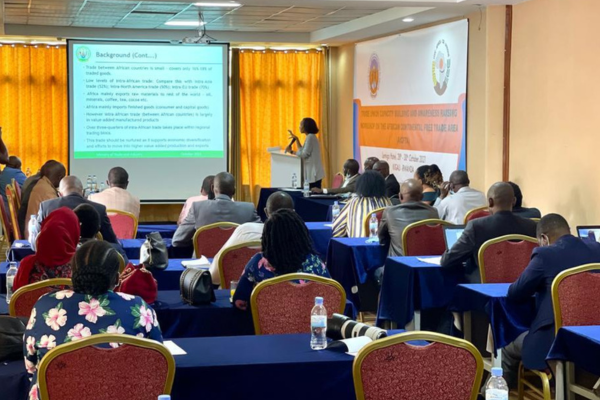
CESTRAR’s advocacy on the AfCFTA focused on identifying stakeholders involved in trade and investment, such as the Ministry of Trade, the Ministry of Labour, employers’ associations, and independent researchers. We prepared motivation letters and concept notes to outline our expectations regarding trade and the AfCFTA. We invited stakeholders to our activities to present on the AfCFTA and the progress of implementation. We also conducted awareness and capacity-building workshops for affiliates, including union leaders, women, and youth.
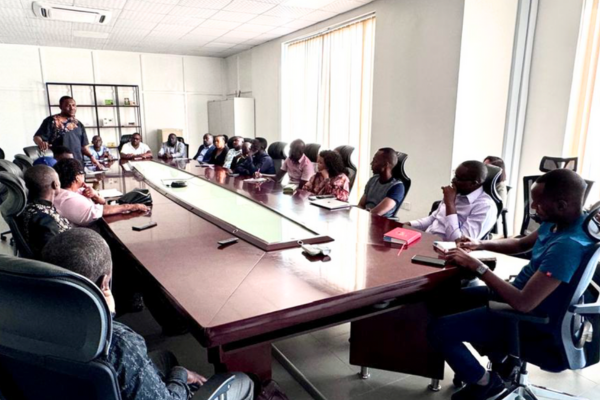
During a sub-regional AfCFTA forum with ITUC-Africa and the East African Trade Union Confederation, the trade ministry facilitated a study visit to Rwanda Mountain Tea, a company exporting under the AfCFTA. Management shared how they leveraged the continental agreement to improve efficiency and growth. The company works closely with CESTRAR and line ministries and agencies to ensure quality and labour standards. Workers are familiar with the AfCFTA e-tariff platform, and labour committees across branches monitor labour standards.
ITUC-Africa General Secretary, Joel Odigie, with EATUC and CESTRAR representatives at the Rwanda Mountain Tea
We formally discussed trade and investment at the CESTRAR Congress in October 2024. Senior government officials attended the event, and we got good media coverage. Ten days after the congress, on the 15th, we determined it was the right time to lodge an official application at the Ministry of Trade for inclusion in the AfCFTA National Implementation Committee, given the series of activities they had participated in and the media visibility. We sent a very professional letter, copied to the Minister of Labour, stating why unions must be part of the National Implementation Committee. The minister immediately confirmed via email that CESTRAR should be part of the National Implementation Committee. We felt confident that it would be a quick process. However, eleven months later, we were still in limbo.
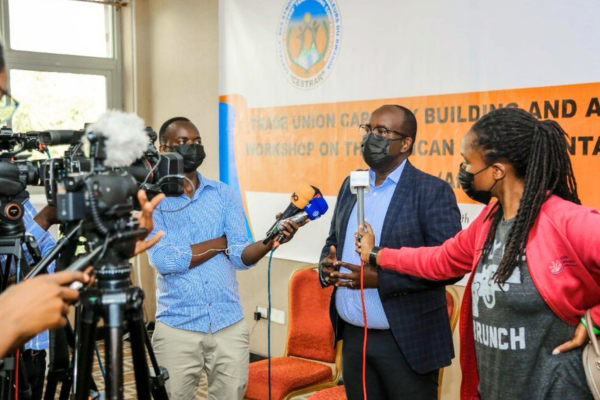
CESTRAR General Secretary, Africain Biraboneye, at a media briefing on the AfCFTA in 2021 in Kigali
Meanwhile, we sustained our advocacy through different channels. For example, the annual labour compliance activity held in the five provinces has a panel with the trade minister. At the panel this year, we demanded to know how many jobs trade and investment create, their quality, and the reasons behind trading relationships. The minister recalled our application, and we followed up with a formal reminder. Two days later, we received confirmation that CESTRAR has two seats on the AfCFTA National Implementation Committee, effective September 2025. We appointed a senior trade unionist alongside our “three-in-one”: a young woman who is a lawyer specialising in trade agreements. Trade is a complex topic, and we must not squander the win. We will continue to develop the capabilities to represent workers well at the National Implementation Committee and in trade policy spaces.