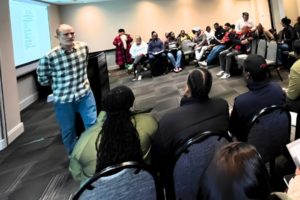

During Pride Month in October, I facilitated a sensitivity conversation for 68 people from the National Professional Teachers’ Organisation of South Africa (NAPTOSA) about human rights, inclusion and safer school communities.
The key message of my presentation was that a union committed to dignity must challenge all forms of exclusion. We do not need to share someone’s experience or beliefs to defend their dignity. We owe every worker and learner one standard: no one is humiliated, discriminated against, denied protection or shut out of support because of who they are.
Here I share what we explored together.
Pride is about the right to live without hiding, fear or shame. It touches the learner who is bullied on the playground, the colleague who stays silent in the staffroom, and the union member who wonders whether the union will stand with them.
Pride came out of the experiences of LGBTQI+ people who were told that who they are, or who they love, was something to keep quiet about. Pride says: “I am not a secret to be kept or a problem to be fixed.”
Pride is a protest. It began as people standing together against violence, police raids and laws that turned their lives into a crime.
Pride is a celebration. Think about what it means to walk into the staffroom, the classroom, a union meeting or your own community without cutting out part of your life: without hiding your partner, without dodging the question “What did you do this weekend?”, without laughing along at a joke that hurts you.
Celebration and protest are both ways of saying: “We are here. Our lives are valued. Our rights matter.”
LGBTQI+ rights in South Africa are part of our longer history of resistance and the fight for democracy.
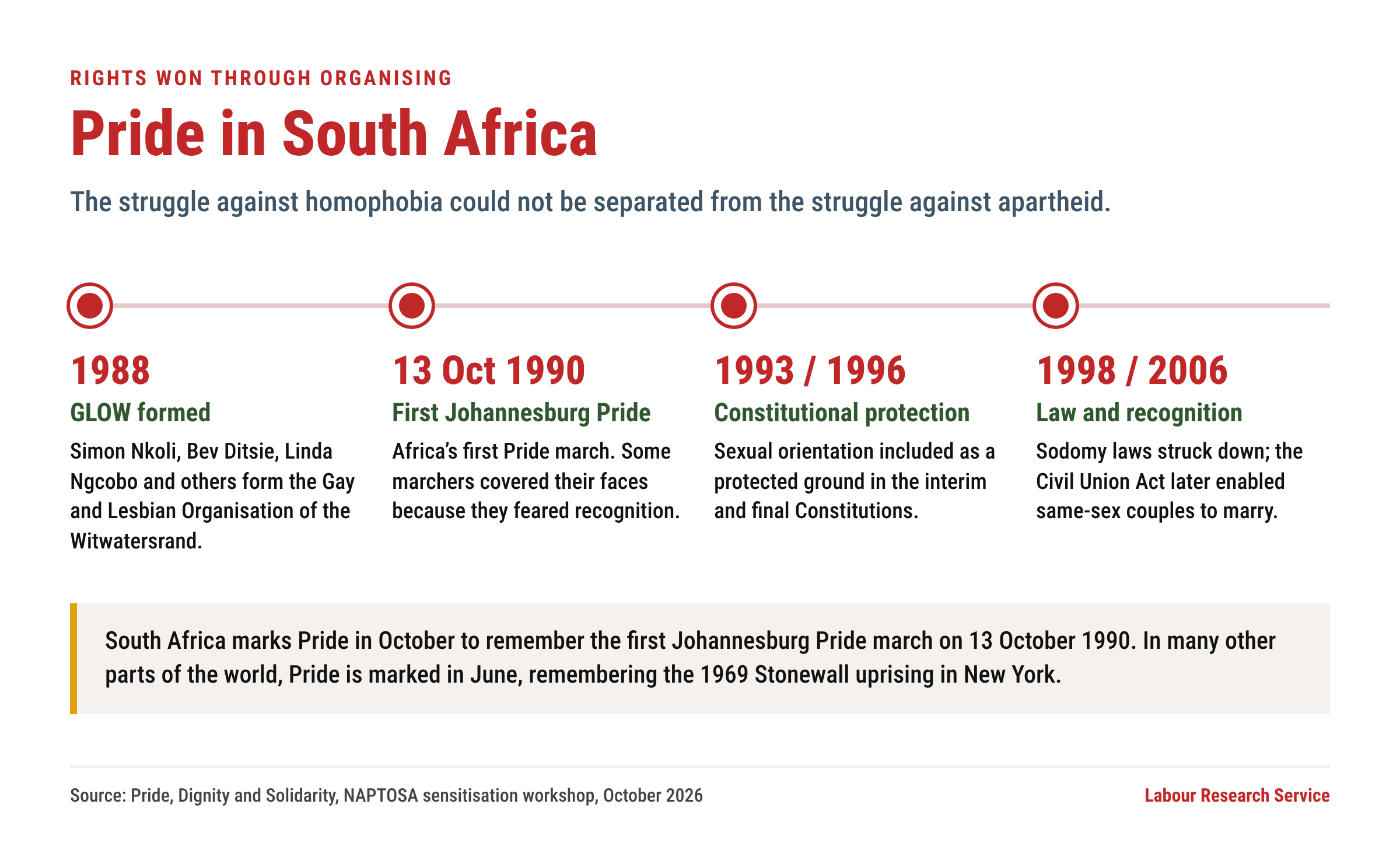
These rights were won through organising They belong to our shared struggle for freedom. But rights on paper are not enough. Rights are weakened every time discrimination is ignored, or when no one is prepared to defend them.
Solidarity begins with seeing each other: why the acronym matters
Maybe you have wondered what all the letters in LGBTQI+ stand for, why the acronym keeps changing, or whether you will say the wrong thing.
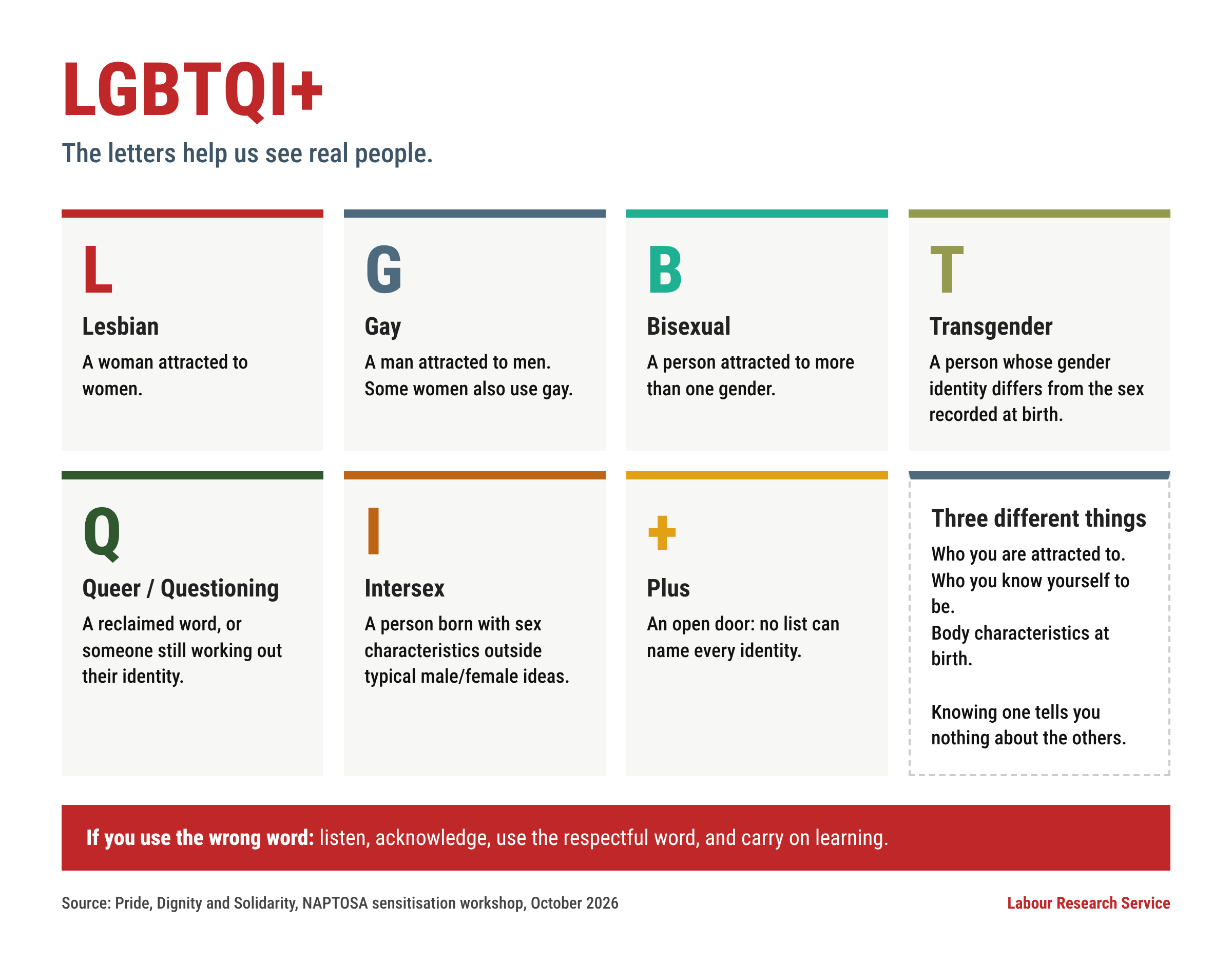
The letters speak about three different parts of a person’s life. They can be connected, but they are not the same thing:
- Who you are attracted to – sometimes called sexual orientation. For example, lesbian, gay or bisexual.
- Who you know yourself to be – sometimes called gender identity. For example, transgender.
- The body characteristics you were born with – sometimes called sex characteristics. For example, intersex.
Each letter was added because a group of people stood up and said: “We are here too, and our experience is not the same.” Think about what this can look like in our schools:
- A lesbian teacher may keep quiet about her partner in the staffroom, or worry that parents will object to her teaching their children.
- A gay learner may be called names and bullied, on the playground and on social media.
- A transgender learner may be mocked about their name, their clothes or the school facilities they use, or may have their personal information shared without their consent.
- An intersex child may face intrusive questions, gossip, or decisions about their body that are made without respect for their dignity and privacy.
From the day we are born, we are handed rules about how boys and girls are supposed to be. “Boys don’t cry.” “Girls must be quiet and soft.” “Men must be breadwinners and make the decisions.” “Women must do the cooking and caring.” “Boys play soccer; girls play with dolls.”
These rules are so familiar that we hardly notice them. The rules are made by people, and are not fixed by nature. Rules change across time and place. Anyone who does not fit the box can be punished for it. So much of the bullying in our schools, and so much of the violence in homes and communities, is about forcing people back into boxes.
LGBTQI+ people have challenged these rules by living openly. In doing so, they have opened up space for all of us, including the boy who loves to cook, the girl who wants to be an engineer, the father who stays home to care for his children, and the woman who becomes a principal.
QUOTe: Which gender rules did you hear while you were growing up? Who gets hurt when these rules are enforced? What becomes possible when people have more freedom to be themselves?
LGBTQI+ inclusion is a worker issue and teacher union issue
The people behind the letters are not only “out there” in the community. They are our colleagues, our support staff, our union members and our learners. When people are mocked, forced to hide or punished for being different, it affects their safety, their work and whether they can take part. That is what makes LGBTQI+ inclusion a worker issue and a union issue.
“An injury to one is an injury to all” cannot only mean the worker whose identity the majority already understands. Solidarity must also protect the worker whose experience is unfamiliar, hidden or pushed to the margins.
A teacher union represents workers, but its members also shape the everyday culture of schools. LGBTQI+ educators and support staff have the same right as every other worker to dignity, safety, fair treatment and a full place in union life. And as teachers, we also carry a professional responsibility to stop bullying and humiliation among learners.
Teachers and education workers stand in three connected spaces:
- The workplace: educators and support staff have rights as workers.
- The union: members should be able to take part fully, without discrimination and without having to hide who they are.
- The school community: educators shape whether learners experience school as a place that is safe, respectful and inclusive.
NAPTOSA policy commitment
NAPTOSA’s Gender Policy, adopted by the NSC on 11 May 2022, places gender equality within a wider commitment to human dignity, human rights and ending injustice. The policy commits NAPTOSA to inclusion regardless of gender or gender identity. It names discrimination based on sexual orientation as an area where the union must act, and it commits the union to champion LGBTQI+ rights.
The practical question for us is, what do the commitments ask of us in our schools, our staffrooms and our union meetings, and in the support we offer members and learners?
We have different religious, cultural and personal beliefs. But what is important is clarity on the shared standard that our professional and union roles ask of us. No person should be humiliated, discriminated against, denied protection or shut out of support because of who they are.
- Interrupt harm. Do not join in, laugh along or remain silent.
- Protect dignity. Respect privacy and do not expose personal information.
- Use your role. Connect the person to appropriate support and union protection.
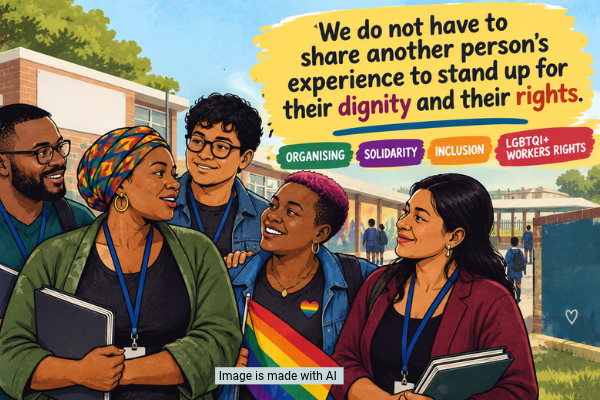
We do not have to share another person’s experience to stand up for their dignity and their rights.
What teachers, colleagues and union representatives can do
We have different religious, cultural and personal beliefs. What is important is clarity on the shared standard that our professional and union roles ask of us: no person should be humiliated, discriminated against, denied protection or shut out of support because of who they are.
We do not have to share another person’s experience to stand up for their dignity and their rights.
Wider solidarity: rights, refuge and belonging
South Africa has strong protections in the Constitution, but discrimination and exclusion are still part of many people’s everyday lives. The Refugees Act of 1998 recognises persecution linked to gender and sexuality as grounds for asylum. Some LGBTQI+ refugees and asylum seekers have fled criminalisation, imprisonment, violence, forced marriage or rejection by their families.
But protection on paper does not always mean safety in real life.
LGBTQI+ refugees and asylum seekers may also face delays in the asylum system, discrimination when they try to use services, and xenophobic hostility. Homophobia, transphobia and xenophobia can land on the same person at the same time. A union that is committed to dignity has to challenge all of them. Solidarity cannot stop at the border.
ESSENTIAL RESOURCES
- Workplace rights belong to everyone: Negotiating for inclusivity and against discrimination
- Practical Guide for Implementing ILO Convention 190 in Public Sector Workplaces
LRS promotes inclusion in the world of work by supporting trade unions to create safe and inclusive workplaces free of homophobia. We support gender and inclusion policy making and education. Know more.
Key contact: Nina Benjamin | [email protected]