

Social dialogue in Africa refers to the institutions and practices that bring together governments, employers, and workers to address issues such as wages, employment, safety, productivity, and the transitions reshaping our economies. The International Labour Organization (ILO) reminds us that effective, ‘peak-level’ social dialogue is fundamental to decent work and a fair social contract, especially in the context of green, digital, and demographic changes. Africa is no exception; in fact, our need for inclusive dialogue is even more urgent – our economies are rapidly changing and our social protection systems must keep pace.
According to the ILO’s broad working definition, the term ‘social dialogue’ includes ‘all types of negotiation, consultation or simply exchange of information between, or among, representatives of governments, employers, workers and lately other civil society groups, on issues of common interest relating to economic and social policy’.
The social dialogue prevailing in most countries, including on the African continent, can be divided into three basic types.
- ‘Bipartite social dialogue’ or ‘bilateral process’ – Usually involves two principal parties, notably the workers’ and the employers’ organisations.
- ‘Tripartite social dialogue’ or ‘three-legged mechanism’ – It involves three parties, notably workers’ and employers’ organisations and the government.
- ‘Multilateral social dialogue’ ‘Tripartite plus’ social dialogue – In this model, other interest groups in society are involved, in addition to the workers’ unions, employers’ organisations and the government, which form the three pillars of social dialogue. This type of social dialogue may also include traditional social partners, the government, and other relevant parties.
Social dialogue, which forms part of the regulation of labour relations in the public and private sectors, can take a variety of forms ranging from the simple act of publishing informal recommendations, or consultation and sharing information, to the most formal and binding negotiated agreements, bargaining or more developed forms of consultation.
Although each country has its own cultural, historical, economic, and political setting, there is a diversity of practices in social dialogue in the public service, for example, and the common model of social dialogue for all countries seems to be freedom of association and the right to collective bargaining. It is, therefore, worth showing how different countries adapt their diverse social dialogue practices in the public service to their national situations.
Where we stand today
Across the continent, the basic enabling framework exists in many countries. A broad swathe of African states have ratified ILO Convention 144 on Tripartite Consultation, committing on paper to regular, representative engagement on labour standards and policy. That roster includes South Africa, Ghana, Nigeria, Morocco, Kenya, Rwanda and many others – evidence that the principle of dialogue enjoys wide normative support even if practice remains uneven. The ILO’s global listings show this convention among the most widely ratified, underscoring the near-universal recognition of its value.
Principles are being stress-tested by structure
Roughly 85% of employment in sub-Saharan Africa is informal. That reality makes it harder to extend collective bargaining, enforce labour standards, or convene representative dialogue that reaches those outside the formal wage sector. It also means social partners must design new mechanisms – community-based organising, sector forums that include informal associations, and hybrid inspection and compliance models – to ensure dialogue is not limited to the minority in formal employment.
What is working – country examples
In South Africa, institutionalised dialogue delivers visible results. During COVID-19, the National Economic Development and Labour Council (NEDLAC) platform enabled rapid agreement on support measures – including the Temporary Employer/Employee Relief Scheme (TERS) through the Unemployment Insurance Fund, which helped protect incomes and enterprises. In the public sector, the Public Service Co-ordinating Bargaining Council (PSCBC) has concluded multi-year wage settlements, illustrating that structured, rules-based bargaining can hold even under fiscal pressure. These experiences show that when institutions are trusted, social partners can trade concessions for stability and reform.
In Ghana, the National Tripartite Committee meets routinely to set the National Daily Minimum Wage. The rate was raised by 22% for 2024 to GHS 18.15 and GHS 19.97 in 2025. This predictability matters. It gives enterprises a planning anchor and ensures the wage floor does not erode silently in high-inflation environments.
In Morocco, successive rounds of national social dialogue culminated in April 2025 commitments to raise public-sector pay and increase minimum wages (SMIG/SMAG), with the government projecting an average net public-sector salary of Moroccan Dirham MAD 10,100 by 2026 and a 50% rise in the public-sector minimum over five years. It is a vivid case of dialogue producing codified, budgeted outcomes rather than declarations alone.
In Zambia, the Tripartite Consultative Labour Council convened a special session in 2024 to reaffirm industrial peace and align stakeholders around wage and employment policies – evidence that dialogue can de-escalate tensions and lay groundwork for reform even in constrained fiscal settings.
Tunisia offers a powerful civic lesson: the National Dialogue Quartet, consisting of the Tunisian General Labour Union (UGTT), employers, legal, and human rights groups, received the 2015 Nobel Peace Prize for successfully mediating a peaceful resolution to a political crisis. This is social dialogue operating at the highest stakes, safeguarding democracy itself.
What is not working
First, coverage. Too many workers and enterprises remain outside the scope of bargaining councils, wages boards, or sector forums, especially in agriculture, domestic work, small-scale construction, and the care economy. Dialogue must be re-tooled to deliberately include informal workers’ associations and micro, small and medium-sized enterprises.
Second, capacity. Labour inspectorates and dispute-resolution bodies are chronically under-resourced; without enforcement, dialogue risks becoming talk.
Third, coordination. African Union and ILO processes warn about fragmentation – multiple initiatives chasing similar goals without coherence, which weakens national ownership and dilutes results.
Fourth, transition pressures. As the ILO notes, countries need dialogue-driven strategies to manage green and digital transitions; absent this, dislocation breeds distrust and resistance.
Public sector: lessons with continental relevance
In South Africa, Kenya, Ghana, and Tunisia, the law recognises the right of state employees to become trade union members and form and join trade unions. The relations between public administration and civil servants have always been built within an organised and highly regulated hierarchical structure governing individual and collective relations in these countries.
However, in Angola, State employees do not usually enjoy their freedom of association. The government must approve the formation and joining of unions. Overall, in the selected countries, civil servants maintain collective relations with the authorities through representative bodies or contacts between civil servants’ associations and/or trade unions and civil servants.
Private and mixed sectors: bringing in more voices
Morocco’s 2025 package reflects classic tripartism translating sector pressures into national choices. Ghana’s Tripartite Committee provides a wage-floor signal to the whole labour market. The Teaching Council of Zambia shows a way to de-risk volatile moments. The call here is to deepen sectoral dialogue – in construction, textiles and apparel, mining, transport, agri-food, and hospitality sectors – so that national frameworks are guided by grounded realities and agreements are implementable along supply chains.
What unions on the continent are asking for
Make inclusion real. Every national social dialogue forum should have a formal, resourced mechanism to include informal-economy representatives and SMEs – through federations, cooperatives and women’s associations – so the 85% are in the room, not on the margins.
Invest in institutions. Tripartite structures need reliable funding, professional secretariats, independent research capacity, and timely data. Convention 144 ratifiers should audit their consultation calendars – and publish minutes, positions, and impact assessments – to rebuild public trust.
Build sector tables that connect to national decisions. Extend and modernise wages councils/bargaining councils in sectors with weak organisation, with legal pathways for extending agreements where representativeness thresholds are met. This is how you lift standards beyond a handful of large employers.
Use dialogue to steer the green and digital transitions. Social partners should co-design national ‘Just Transition compacts’ – mapping reskilling, income support, OSH upgrades, and investment incentives – so climate and tech policies create decent work instead of dislocation.
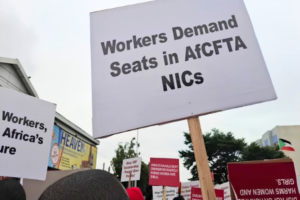
Anchor social dialogue in continental agendas. The African Union’s Agenda 2063 and labour ministers’ platforms emphasise employment, social protection, and social cohesion. Tripartite bodies should explicitly align national compacts with these priorities and with AfCFTA implementation, ensuring trade integration goes hand-in-hand with labour standards and voice.
Outcomes and credibility
Social dialogue earns legitimacy when it delivers: a wage floor that tracks living costs (Ghana), transparent and implementable public-sector settlements (South Africa), and multi-year reforms that reach households (Morocco). These are the problem-solving engines when designed well. NEDLAC’s COVID rapid response shows us when the house is on fire, trusted dialogue can produce quick and targeted policy that protects jobs and incomes. We should not wait for crises to build that trust.