
7 GBVH clauses unions must demand at the bargaining table

Nina Benjamin

7 GBVH clauses unions must demand at the bargaining table

GBVH is a labour relations and organisational power issue. The fix must be too.

Gender-based violence and harassment (GBVH) in the workplace is a core labour relations problem — and, at its root, a power problem. Who holds power in the workplace? How do they use it? What protections can workers, especially women workers, rely on in the world of work? These are some of the questions behind every incident of workplace violence and harassment that laws and and collective bargaining must address.

Gender-based violence and harassment is about power

GBVH persists because of unequal power relations that are built into how work is organised: supervisors over workers, permanent employees over casuals, men over women, employers over unions, and customers and third parties over frontline staff.

ILO Convention 190 is explicit about this.

Violence and harassment in the world of work emerge wherever power is imbalanced — whether that imbalance is physical, economic, contractual, or gendered. Naming the power dynamic is the precondition for any meaningful response.

The evidence in collective bargaining agreements 

We used claude.ai to analyse ILO C190, gender based violence and workplace harassment provisions in 1,433 collective bargaining agreements on LRS Agreements Database (AGREED), spanning 26 years. The analysis shows that GBVH has been almost entirely absent from collective bargaining in South Africa.

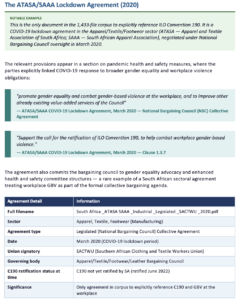
  • Only one agreement in the entire collection explicitly references ILO Convention 190 or gender-based violence — the Apparel and Textile Association of South Africa (ATASA) and the South African Apparel Association (SAAA) COVID-19 Lockdown Agreement of March 2020, signed by South African Textiles Workers Union (more on this below).
  • Only two agreements contain explicit sexual harassment provisions, and both are international instruments.
  • Not a single local agreement defines or prohibits bullying.
  • When agreements use the word “victimisation,” they mean retaliation against union members, not protection for GBV survivors.
  • The most common provisions related to home/family are family responsibility leave, but these do not explicitly recognise domestic violence.
  • “Workplace dignity” appears in just two University of Cape Town agreements, but without any accompanying procedures or enforcement mechanisms.

Our analysis tell us that GBVH belongs in the HR policy folder. In our sample of collective agreements, GBVH almost never appears in bargaining clauses, which shows that unions and employers have not been negotiating enforceable rights around violence and harassment.

Labour and power issues matter 

GBVH has been handled mainly through internal human resources policies. HR policies can be rewritten overnight. Collective bargaining agreements cannot. When GBVH is left to employer discretion, bosses decide everything: how complaints are investigated, who receives protection, how perpetrators are disciplined, whether survivors are supported or pushed out.

Workers have no collective power in GBVH disputes. Without bargaining clauses, shop stewards have no leverage, and unions cannot trigger formal dispute mechanisms. GBVH becomes an individualised issue isolating survivors, which is how it survives.

Leaving GBVH outside the bargaining framework fails survivors and leaves intact the structural power behind it.

Lesson from the HIV/AIDS precedent

We have an example of how an issue becomes a labour relations issue: In the early 2000s, workers forced HIV/AIDS onto bargaining agendas. The result is 136 collective agreements containing concrete HIV/AIDS clauses, covering confidentiality, non-discrimination, and access to care.
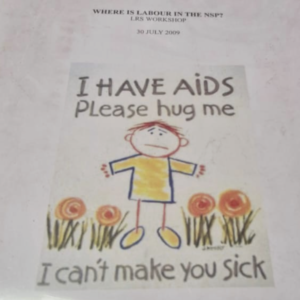
The trajectory of HIV/AIDS in collective bargaining is the model GBVH must follow. When workers organise around a vulnerability, it becomes a bargaining issue, not just policy.

GBVH as organisational power

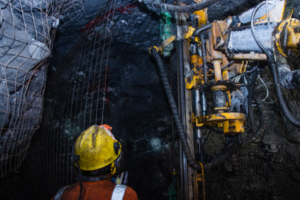
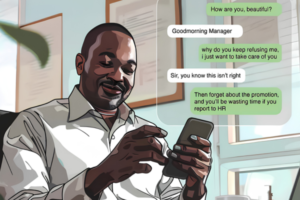
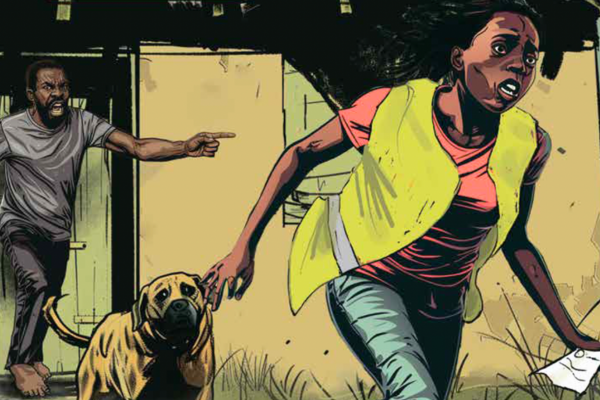
GBVH thrives wherever employer and supervisors hold unchecked power and workers have limited agency, for example, casual workers on insecure contracts, young women in retail and hospitality, women in male-dominated sectors like mining and manufacturing,  Community Health Workers and Expanded Public Works Programme workers with no formal protections, and frontline workers exposed to customer violence. In these settings,  the employment relationship is often the mechanism enforcing GBVH. Violence is used to discipline, silence, and control women workers. The struggle against GBVH is, therefore, a struggle against exploitation, precarity, and authoritarian management practices.

Seven GBVH clauses that must feature in our collective bargaining agreements

To reposition GBVH as a labour relations and power issue, trade unions can demand the embedding of GBVH‑specific clauses in all new agreements. At minimum, unions should demand the following in all new agreements:

  1. C190-aligned definitions in every collective bargaining agreement. Agreements should define violence, harassment, bullying, third-party violence, and the workplace impacts of domestic violence.
  2. Joint (union and management) GBVH committees.
  3. Embedded survivor-centred reporting and investigation procedures.
  4. Domestic violence leave. The Domestic Violence Amendment Act creates the framework from which to expand  family responsibility leave provisions.
  5. Protection against retaliation. Explicit anti-retaliation clauses preventing victimisation of complainants and the shop stewards handling cases. 
  6. Third-party violence provisions, especially for retail, healthcare, transport, and hospitality sectors.
  7. Annual gender power audits, to map structural vulnerabilities in workloads, line management, rostering, and promotions. 

Bringing power back to workers

If GBVH is rooted in power, then the response must be rooted in worker power too. When unions embed these rights in collective bargaining agreements, they shift power from employers to workers, from isolated individuals to the collective, and from silence to accountability. The struggle against GBVH is a struggle for dignity, equality and worker control. It is part of the broader struggle to transform the workplace, not only to protect women workers, but to democratise power itself. Collective bargaining can make a historic shift — moving GBVH from being treated as a private, individual problem to being recognised as a collective, structural and negotiable workers’ rights issue.

A note on the ATASA/SAAA agreement

The ATASA/SAAA COVID-19 Lockdown Agreement, concluded in March 2020 under the apparel, textile, footwear, and leather bargaining Council, was signed by SACTWU at a moment when workplaces were scrambling to respond to the pandemic. 

The parties linked the COVID-19 response explicitly to broader gender equality obligations and commits to “promote gender equality and combat gender-based violence at the workplace” and to “support the call for the ratification of ILO Convention 190, to help combat workplace gender-based violence.” [South Africa ratified C190 in November 2021 and enforced in November 2022]. The agreement also commits the bargaining council to gender equality advocacy and enhanced health and safety committee structures — a rare example of a South African sectoral agreement treating workplace GBV as part of the formal collective bargaining agenda.

It is the only agreement referencing ILO Convention 190 and gender-based violence in our sample of 1,433 collective bargaining agreements. This is a testimony for SACTWU. It is also an indictment of what has not happened since.
Source: LRS Agreements Database

Click here to expand image

This aricle draws on LRS presentation at the COSATU National Gender Conference, 26–27 March 2026, and a thematic analysis of the LRS Agreements Database (AGREED).


RELATED RESOURCES

Recent Posts

Essential Links

Essential Resources

Tags Cloud

Subscribe to receive our email updates

I am interested in: