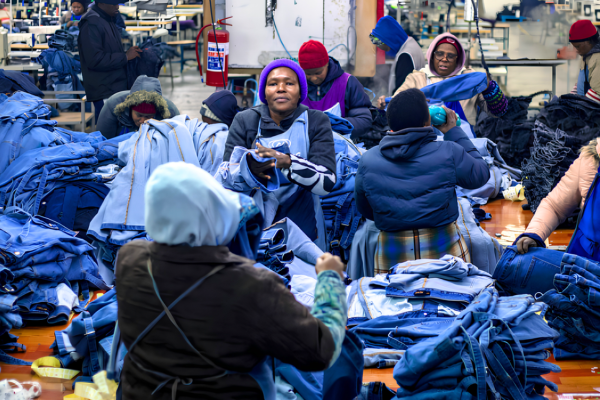
Photo credit: Per-Anders Pettersson/Getty Images
Testimonies from garment workers in Lesotho’s anti-Gender-Based Violence and Harassment (GBVH) programme show what makes a policy workers trust.
In May 2026, I was in Lesotho to evaluate the Anti-GBVH Programme in garment factories owned by Nien Hsing Textile Co., Ltd. The programme emerged from landmark binding agreements signed in 2019 to prevent and respond to gender-based violence and harassment in the factories.
The agreements incorporate key elements of ILO Convention 190, including a broad understanding of violence and harassment in the world of work, and freedom of association as a core enabling right through which workers can collectively challenge GBVH.
The agreements followed a Worker Rights Consortium investigation that found widespread sexual harassment, coercion and abuse affecting women workers.
The Anti-GBVH Programme was negotiated by a coalition of Lesotho trade unions, women’s rights organisations, together with international labour rights organisations, apparel brands and the supplier.
I was there to evaluate what had changed for workers and others involved in the programme, and to understand how that change had happened.
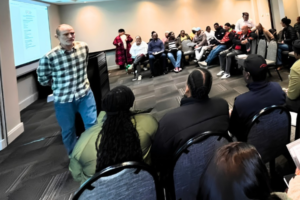
We used storytelling-based qualitative research. We held in person and online focus group discussions with employed workers, retrenched workers, worker trainers, human resource managers, supervisors, management and programme partners. The discussions explored participants’ experiences of the programme, the changes they associated with it and the challenges that remain.
I used the Gender at Work Framework to interpret what we heard. The framework looks at change across four connected dimensions: workers’ beliefs and understanding; their confidence and ability to act; workplace rules, policies and enforcement systems; and norms and relationships.
I wanted to hear what changes meant in workers’ everyday lives. What did they notice? What were they now able to do that they could not do before? Had relationships on the factory floor changed?
One of the stories was about a wall of posters.
The posters show laws, policies and the Anti-GBVH Code. But the wall is not simply a place for information.
“When someone is harassing you or behaving inappropriately and you do not want to speak to them directly, you just point them to the wall and they immediately stop. The wall is loud enough,” said a worker.
Before the programme, workers described workplaces where shouting, humiliation, sexual jokes, unwanted touching, threats and sexual coercion had become part of everyday working life. Workers knew the risks of speaking out. A complaint might disappear. A contract might not be renewed. Overtime could be withheld.
“We did not know where to report… we did not know what to do about this behaviour,” one worker recalled.
Formal rules against sexual harassment already existed. But workers did not trust them. They did not have easy access to the rules, and they had not experienced them as enforceable. Supervisors on the factory floor held considerable power.
What made the rules credible
Through the programme, workers received training on GBVH and could use a confidential toll-free information line. Trade unions played a central role in the training, alongside Women and Law in Southern Africa Research and Education Trust-Lesotho. An independent body under Workers’ Rights Watch was responsible for investigating and determining complaints. An implementation oversight committee comprised unions, women’s rights organisations and clothing brands.
A policy can exist without workers knowing about it. Workers can know about it without understanding what it means. They can understand it without believing that anything will happen if they use it.
The framework we used invites us to see the different dimensions of change. The worker stories show all four dimensions.
Consciousness – “It was like a veil lifted’’
Workers spoke about a shift in their understanding of behaviour they had previously regarded as normal.
“We learned that touching someone without consent is violence,” one worker said. Another described the experience as: “…It felt like a veil was lifted.”
Before the training, unwanted touching, shouting, sexual comments and intimidation had become part of everyday life in the factory. Workers learned that harassment was not only about physical acts. Threats, humiliation and insulting language could also constitute violence and harassment.
Supervisors described their own shift in understanding: “I felt ashamed that what we thought were jokes was harassment.”
The programme also challenged attitudes towards LGBT+ workers. Workers spoke about stereotypes and assumptions they had previously held, and about learning to respect people regardless of their sexual orientation or gender identity.
Capabilities – building voice and confidence
Workers described becoming more confident to speak, intervene, question behaviour and use the reporting mechanism.
“The training helped us increase our voice,” one worker said. Another described what that voice could sound like when confronting an abusive supervisor: “Stop it, or else I will report you.”
Workers had seen complaints investigated, cases addressed and perpetrators disciplined. As they saw the system working, reporting became more acceptable and their confidence in using it grew. The training, worker discussions, union involvement and sharing of experiences also created a sense of solidarity. Workers felt that they were not alone in dealing with violence.
Formal rules – enforcing accountability
Workers had known that workplace rules existed. The problem was that they did not believe the rules would protect them. That changed when workers began to see complaints investigated and perpetrators disciplined. The formal rules became more credible because workers could see them being used.
“Watch (Workers’ Rights Watch), not HR, investigated complaints of sexual harassment… cases were concluded in less than two months,” said a worker.
The independent complaints and accountability system through Workers’ Rights Watch was important because workers trusted it. The programme also strengthened workplace policies and codes of conduct, while collective agreements created obligations for the companies and brands involved.
Workers linked reduced vulnerability to the move away from highly insecure contracts, and one participant said the demands for money and sexual favours stopped. Insecure employment had previously increased their vulnerability because supervisors could influence recruitment, contract renewal, overtime and work allocation.
Norms – changing workplace culture
Workers talked about changes in everyday interactions.
“Managers have improved their communication, and there is mutual respect between workers and supervisors.”
Managers became more professional and stopped inappropriate jokes. Workers described moving away from derogatory comments and labelling towards supporting one another and working together: “Before, harassment was normal. Now it is not acceptable.”
GBVH was no longer being treated as something people had to put up with. Workers were challenging behaviour, and supervisors were changing their own behaviour. The expectation of what is acceptable in the workplace shifted.
Power does not run on gender alone
The programme was designed to address gender-based violence and harassment. But the stories workers told show that GBVH was also embedded in workplace hierarchies shaped by race, nationality, class, employment status and managerial authority.
Many workers described a factory where Basotho workers held lower-paid production roles, and where Chinese managers and supervisors held disproportionate power over promotion, contract renewal, overtime, discipline, work allocation and everyday treatment on the floor.
Several participants said they were surprised that Chinese supervisors and managers could be reported, investigated, disciplined or dismissed when they violated the Code of Conduct. That surprise is worth sitting with. It tells us how deeply workers had come to believe that the rules applied unevenly, and that some people were beyond scrutiny.
Workers also complicated their own analysis. Some described first seeing “light-skinned” foreign employees as one privileged group, and then learning that Filipino workers could face exploitation and difficult living conditions too. Nationality intersects with migration status, class, role and closeness to managerial power.
What has not changed
Where workers once feared that a complaint would be ignored, some now describe more indirect forms of retaliation. Closer monitoring. Difficult interactions with supervisors. Being given heavy or unpleasant tasks. Being targeted in ways that cannot easily be traced back to a formal complaint.
“GBVH has reduced, but the supervisors are retaliating somehow by using the scorecard and their power to frustrate workers, especially those who report. They do not openly bully but use work and power as a new form of bullying,” one worker said.
And not everyone reports. For newer workers, younger workers and those with fewer support networks, coming forward can still feel intimidating.
Interconnected change
An interesting thing in the focus groups was how difficult it was for workers to describe one kind of change without moving into another.
When they spoke about learning something new, they soon talked about confidence. When they spoke about confidence, they talked about reporting. Reporting led to stories of complaints being investigated and supervisors changing their behaviour. Those changes led back to how relationships in the workplace now felt.
The programme as an interconnected process of change. Training alone would not have been enough if workers did not trust the reporting system. A reporting mechanism would not have worked if workers did not recognise harassment or were too afraid to act. Policies would have had limited impact if workplace culture continued to tolerate abuse.
Nina Benjamin is Co-ordinator of LRS Gender Equality Programme.
RELATED ARTICLES
7 GBVH clauses unions must demand at the bargaining table
Actions we can take to stop GBVH in garment factories and clothing retail stores
Why proudly South African clothes are being made in “sweatshops”