

Work is not experienced the same way by everyone. Women, LGBT+ workers, and those in precarious employment often experience inequality, invisibility, and exclusion. LRS addresses the structural and cultural forces that make workplaces unequal. Our work centres on five interconnected themes: promoting the value of care work as essential to a just society; strengthening transformative women’s leadership in the labour movement; creating workplaces free of gender-based violence; using an intersectional analysis to promote inclusion; and using feminist pedagogy that engages workers as whole people — at the head, heart and feet levels.
Belonging is more than feeling welcome
Strong unions ensure all members can speak safely and are represented in agendas, policies and leadership. Unions themselves are not always safe or inclusive spaces, particularly for women and marginalised workers. When people cannot bring their whole selves into their organisations, unions lose the depth of experience, knowledge and energy they need to represent workers effectively. Intentional organisational transformation — through feminist leadership, strong gender policies, and intersectional practice — are central to building and sustaining democratic organisations.
LRS walks alongside trade unions, federations and worker formations to strengthen the transforming of unequal gender relations in the World of Work.
Hightlights in 2025:
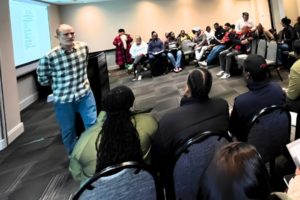
COSATU feminist school: Women trade unionists reflected on forty years of struggle through the Herstories project, and to build the next generation of feminist leadership. Key themes included gender equality, ending sexism and discrimination, expanding human choice and freedom, challenging structural inequalities, and promoting care, dignity, and collective responsibility.
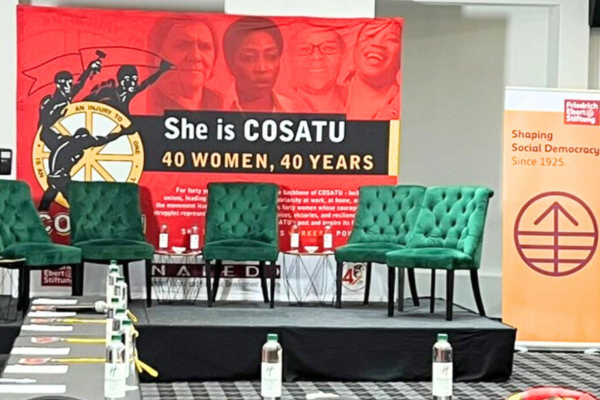
LRS presented on feminist leadership struggles and internalised oppression, and feminist economic justice in the care economy.
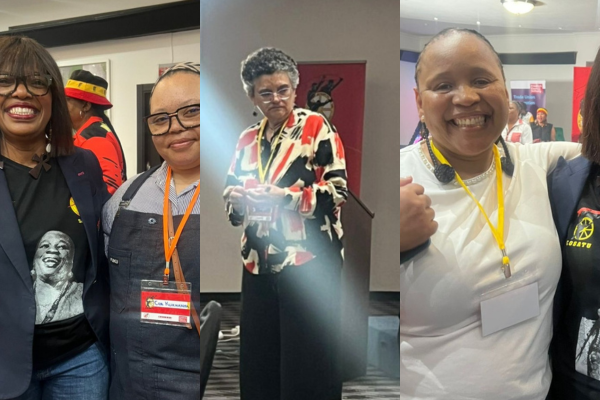
FEDUSA national gender conference: Union leaders and activists reflected on feminism, intersectionality and the persistence of patriarchal norms in trade unions. Participants acknowledged that unions are not always safe or inclusive spaces for women leaders and activists, which undermines belonging in the labour movement. LRS gave input on internalised oppression.
Gender equality practice at Democratic Nursing Organisation of South Africa (DENOSA): LRS facilitated DENOSA’s reflection process for the development of a gender policy. We believes that to achieve gender equality requires strong polices and continuous organisational reflection and transformation. DENOSA’s policy embeds gender equality in the nursing profession and the union, and recognises that entrenched stereotypes, for example, the assumption that care work is women’s work and therefore undervalued, perpetuates gender inequality in workplaces. DENOSA is striving to address stereotypes, women’s leadership and representation, and inclusion through its gender policy.
NUM launches inaugural LGBT+ campaign: LRS supported NUM Women’s Structure Committee to develop the union’s first LGBT+ policy and the launch of its inaugural LGBT+ rights campaign. LGBT+ members shared their experiences with leaders for the first time.
SACTWU workers research into GBV: LRS is walking alongside educators from the Southern African Clothing and Textile Workers’ Union (SACTWU) leading a new participatory action research into gender-based violence and harassment in garment factories and clothing retail stores, where 98% of women workers surveyed reported having experienced some form of GBV or harassment. LRS support includes mentorship, methodology and design, and educational resources.
The collective ‘coming out’ of care workers in EPWP: The process of informalisation leads to a fragmented sense of identity. Nowhere is that fragmentation sharper than in the Expanded Public Works Programme (EPWP), where predominantly women perform essential care work under conditions designed to blur lines. Across nutrition, early learning and healing, the State entrust the wellbeing of an entire generation of children to women, while failing to recognise and reward this labour as decent work.
LRS enabled the conditions for care workers to name their identity and analyse their work collectively. Our Transforming Public Care Programmes in South Africa initiative brings together three EPWP care worker groups: Food Handlers organised under the Gauteng Forum, Early Childhood Development practitioners organised under the South African Democratic Teachers’ Union, and Community Health Workers in the South African Care Workers Forum to advocate for decent work and fair remuneration.
Care workers are challenging the fragmentation by naming themselves publicly as care workers, activists, women and breadwinners. In 2025, they established a national care workers platform for advocacy, 7 February as Care Workers’ Day, five collective demands for decent care work, and 60 care worker stories for advocacy.
"The emotional, financial, and mental well-being of care workers has been overlooked for too long. Now, as the muzzles fall away and our voices are heard, we begin to recognise our collective value. And it is more than voice, it is sound. Sound travels. It carries frequency. Sound moves far beyond its point of origin. The sound we carry holds power, which is our currency.
– Sheila Martins, ECD Practitioner
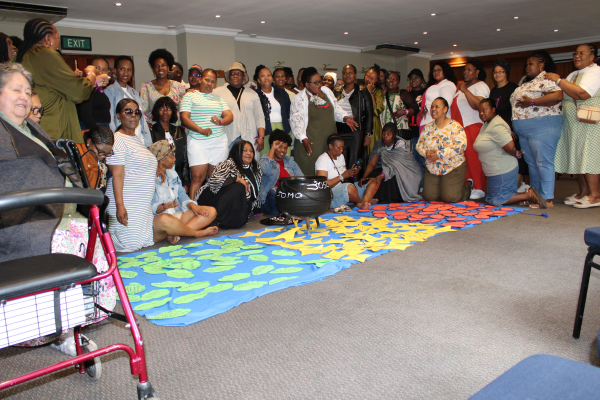
LRS Care Workers Convergence, a festival of stories hosted in partnership with the South African Care Workers Forum, the South African Democratic Teachers’ Union, and a Food Handlers collective | October 2025,Johannesburg.
Resources
- Bargaining for gender equity
- Workplace rights belong to everyone: Negotiating for inclusivity and against discrimination
- A framework for negotiating conditions at work
- Facilitation toolkit for facilitators and educators
- Practical Guide for Implementing ILO Convention 190 in Public Sector Workplaces
In this series:
Identity | The collective ‘coming out’ of care workers in the Expanded Public Works Programme
Voice | How workers’ voice is shaping trade policy
Capacity | for organising and representing worker interests
Sustainability | through programme development