

LRS provides research and practical tools to help workers and their representatives adapt to the changing world of work.
Trade unions must continuously develop skills and strategies to organise and represent workers effectively in a changing world of work.
LRS contributes to trade union development as convener, interpreter, translator, knowledge broker and space holder.
LRS operates at the intersection of research, worker education and policy engagement. We focus on applied, participatory and action research that strengthens the ability of workers to investigate their own conditions, generate evidence and with this evidence shape policy outcomes. Our feminist popular education approach sees workers as producers of knowledge.
This is a story on our work in 2025 supporting trade unions and worker formations to navigate current and future issues in the changing world of work.
Strengthening bargaining and negotiation skills
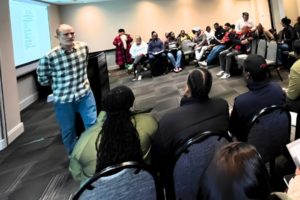
961 officials and worker leaders participated in the LRS learning programme supported by the National Skills Fund. Workshops focused on wage bargaining, negotiations, organising in informal and vulnerable sectors, labour law literacy and bargaining for gender equity and safety.
Participants from LRS member unions, including CEPPWAWU, NUM, SATAWU, NEHAWU and SACCAWU, are better equipped and more self-sufficient in using LRS resources and tools to prepare for negotiations and campaigns.
“LRS put my strength to another level. I have changed my thinking of what my role as a shop steward is.”
– Sinethemba Nyumbeka, Shop steward at Bimbo QSR
At Sibanye-Stillwater, 50 NUM shop stewards and officials can now distinguish between nominal and real wages, factor inflation into bargaining demands and better understand the roles of bargaining teams.
“A wonderful presentation on preparation for bargaining. LRS resources and tools like the wage calculator are quite useful. Keep up the good work.”
– Ntsane Monaheng, Head of Collective Bargaining Unit, National Union of Mine Workers
Wage bargaining snapshot
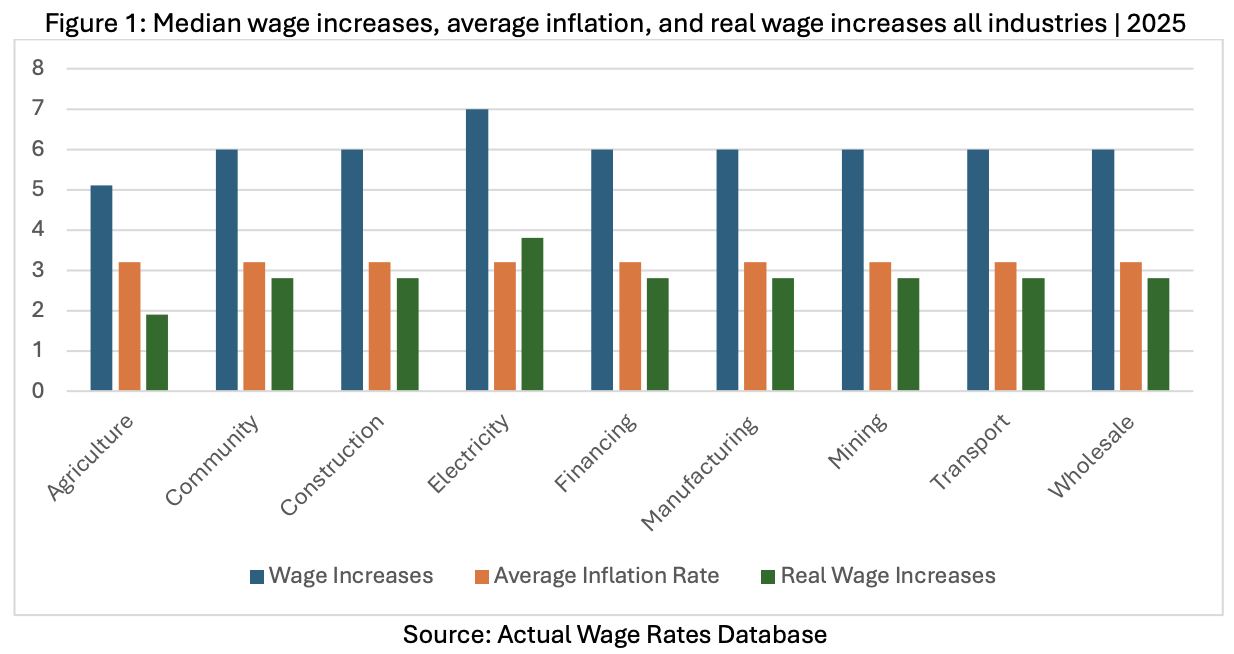
Median wage settlement levels were above inflation in 2025, meaning workers experienced real wage increases. Minimum wages rose across all sectors, including the National Minimum Wage.
The average inflation rate was 3.2% in 2025.
Electricity and water sector recorded the highest median wage increase of 7%, resulting in a real wage increase of 3.8%.
The agriculture sector recorded the lowest median wage increase.
The national minimum wage increased by 4.4% to R28.79 per ordinary hour.
Expanding bargaining capacity across borders
Retail trade unions in eight African countries improved their bargaining outcomes and strengthened cross-border solidarity to confront South African retail multinationals.
Forty-six shop stewards at Shoprite, Pick n Pay and Massmart in South Africa, eSwatini, Lesotho, Mozambique, Malawi, Zambia, Zimbabwe and Ghana shared organising and bargaining experiences through UNI Global Shop Stewards Alliance meetings.
LRS provided company information, financial literacy and insights to support bargaining strategies and responses to the changes in retail, such as the rise of part-time and flexible work, automation, data mining, and data rights.
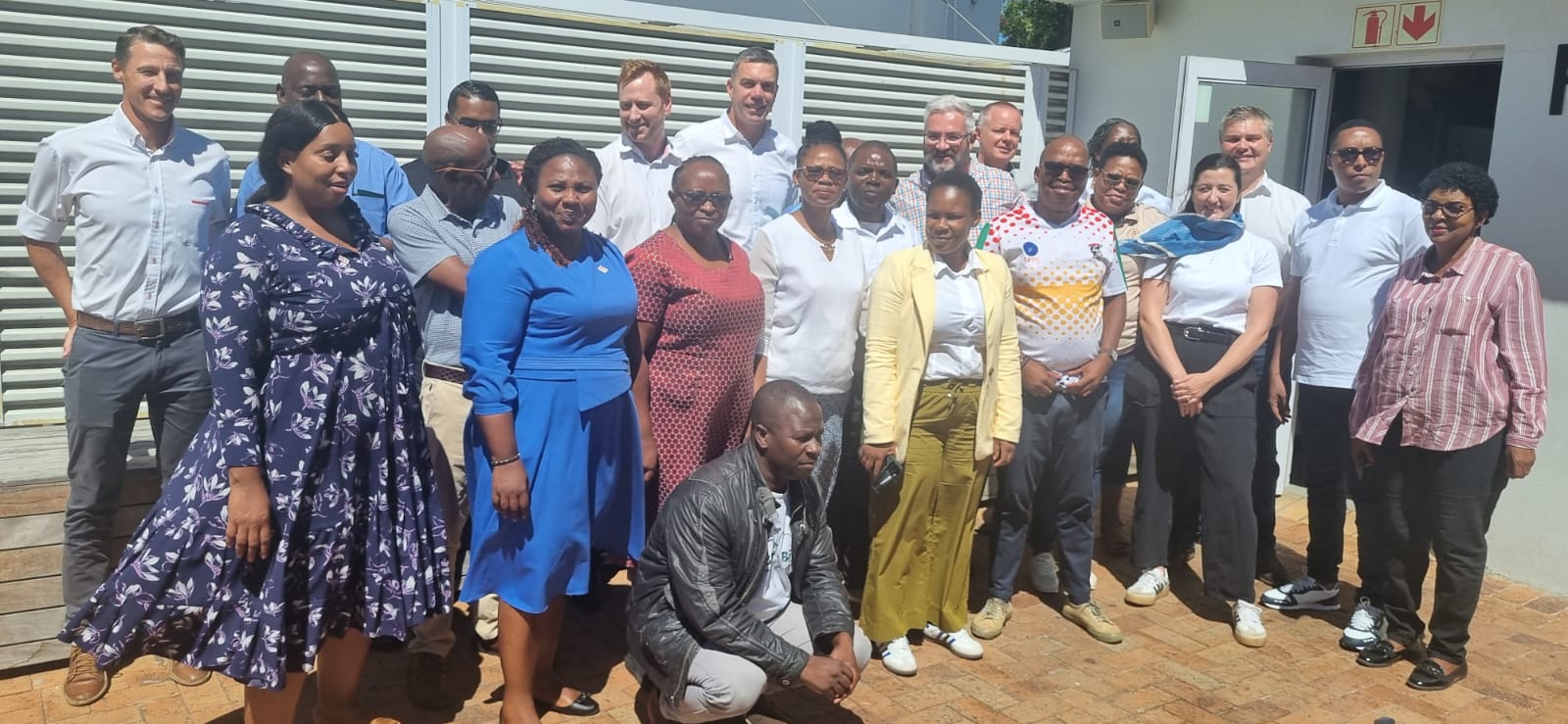
Participants of 2025 UNI Global Shop Stewards Alliance meeting
"The input from LRS has proven to be a cornerstone of our preparation and strategy at the Swaziland Commercial and Allied Workers Union (SCAWU). The annual sessions are consistently packed with high-quality, credible information and discussions, and help us to benchmark, compare trends, and understand broader labour dynamics within the retail sector. Your website and data tools further strengthen our capacity."
– Philasande Mthethwa, General Secretary of SCAWU.
Productivity ecosystems and decent work
LRS contributed a labour perspective to an ILO capacity development programme on productivity and collective bargaining. Productivity is often used to justify wage restraint. Our input examined the relationship between productivity, wage determination and decent work, emphasising that productivity debates are political and influenced by factors beyond workers’ control, and the need for bargaining with evidence.
Organising workers in precarious sectors
LRS works with workers organising outside traditional employment relationships.
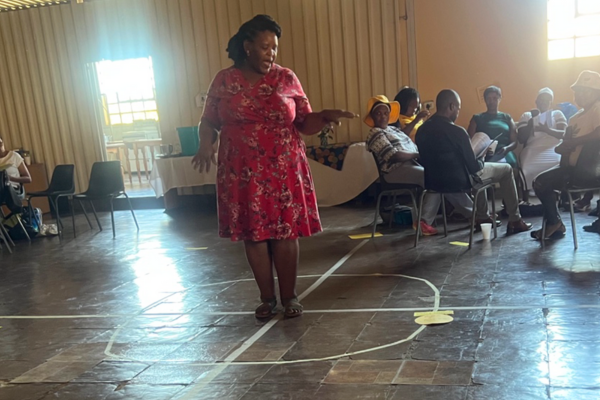
Taking forward the food handlers' struggle using the Gender at Work Analytical Framework, a tool for understanding where change is needed | LRS Thinking Laboratory in the Vaal, October 2025
Volunteer Food Handlers explored the question: what does the national budget say about how the government values care work? Our series of thinking laboratories were spaces for critical analysis, problem-solving and creative exploration of what it will take to create an effective care economy and an economy that cares. Food handlers analysed national budgets and allocations to the National School Nutrition Programme, and explored strategies to influence allocations.
“It makes more sense now when they say only one per cent of the basic education department budget goes to the National School Nutrition Programme. We can say it, and we have demands on valuing care work."
– Volunteer Food Handler
Food Handlers proposed recommendations for a more effective school nutrition programme, including decent work, promoting food sovereignty, a decolonised nutrition system, and recognising food as a social justice issue.
“The norm that refuses to see us as workers deserving of decent work must change. The norm is that I am not a worker because I am recruited through my child. The assumption is that the school is doing me a favour and my presence is conditional. I have no sick leave. The school is saying, if you are busy trying to be a princess and want to get sick, who is going to cook for your child?”
– Zodwa Rannyadi, Former Volunteer Food Handler
Access granted: The struggle of volunteer Food Handlers to access UIF
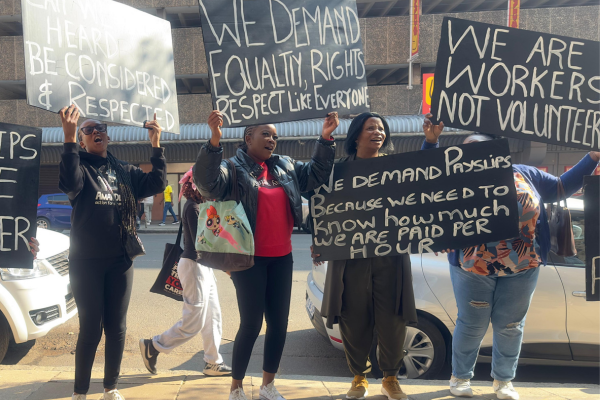
Volunteer Food Handlers working in the National School Nutrition Programme successfully claimed Unemployment Insurance Fund (UIF) benefits collectively for the first time. Their campaign led to practical changes in how UIF claims are processed and a key policy shift: the Department of Basic Education removed the term “volunteer” from their job title.
These changes have begun to reduce the barriers that previously made UIF claims almost impossible for food handlers whose contracts ran for two years.
Food handlers were historically treated as “volunteers”. Attempts to claim UIF often involved long delays, misinformation, and humiliating treatment at the schools and labour offices.
“The UIF process is depressing enough, and then I am being ridiculed and treated like a nuisance when I try to get my UIF. The school community is making a joke out of our poverty… I feel angry, and I don’t sleep because the staff humiliates me to the point I feel like an invalid.”
— Former Volunteer Food Handler
The LRS had been working with this group of Volunteer Food Handlers for two years strengthening their political awareness and collective identity. When their contracts ended in 2025, food handlers transformed what had previously been individual struggles into a collective and coordinated action. They organised protests outside Department of Labour offices and presented demands, used social media to amplify their campaign, and collaborated with the community advocacy platform Amandla.mobi to launch an online petition demanding a national minimum wage and rights, including UIF access.
In schools, some principals began actively supporting UIF access by transporting Volunteer Food Handlers to register and facilitating smoother handovers between outgoing and incoming food handlers.
Department of Labour and Employment officials introduced dedicated points for food handlers that massively reduced bureaucracy.
At the Department of Basic Education, legal pressure by LRS pro bono partner, Webber Wentzel, led to the removal of the term ‘volunteer’ from their job titles, and circulars directing principals to adhere to UIF processes.
The response from the Department of Basic Education and the Department of Employment and Labour marks an important norm shift, as Food Handlers demand that the government align its actions with legal obligations toward workers who have historically lacked the voice to demand compliance.
“With my UIF, I have joined a group of women who go to Durban every month to buy stock. With this stock, I can sell to the community. I also sell small packs of vegetables.”
— Former Volunteer Food Handler
LRS empowered food handlers by building political awareness and confidence to articulate their rights and analyse the systemic barriers. We strengthened the UIF campaign’s visibility online through the website, and email and social media campaigns.
These changes challenge gender norms that devalue women’s care work by recognising Volunteer Food Handlers as legitimate workers entitled to UIF. They also strengthen women’s confidence, political agency and organising power. They set precedents that can influence the treatment of other care workers in the Expanded Public Works Programme.
Renewed organising approaches in precarious work
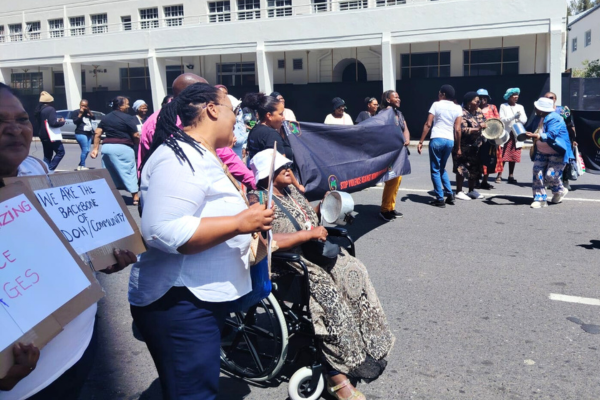
Community Health Workers joined other civil society groups protesting outside parliament during the national budget speech in 2026. SACWF mobilised for the protest through provincial and district structures, WhatsApp networks, word of mouth, and coordination with civil society partners.
Workers often organise most effectively during crises. For the South African Care Workers Forum (SACWF), delayed stipends, outsourcing of Community Health Workers to NGOs by the Western Cape health department, and lack of permanent jobs prompted organisational renewal.
LRS supported SACWF to document recruitment and organising principles. These principles explain why recruitment matters, the recruiting tools available and what SACWF offers potential members.
The recruitment principles help promote organisational identity in the four provinces where SACWF has a strong presence, and beyond. In the Free State, LRS and SACWF brought together 80 Community Health Workers from rural areas in a rare face-to-face organising space. SACWF’s leadership and coordination is enhanced, and members have energy to revitalise organisation in the province.
Community Health Workers are also using innovative ways to self-organise.
When thousands of Community Health Workers in the Eastern Cape went unpaid for three months, SACWF used WhatsApp networks to successfully rally support and coordinate action, while LRS held Zoom spaces where Community Health Workers from different provinces jointly developed response strategies and shared lessons after the actions.
“In the end, it was us, the care workers, who went to the offices, demanded answers, and secured our stipends.”
— Bulelwa Faltein, SACWF Organiser
Organising women in informal cross-border trade
The Union of Trade Unions of Chad (UST) in the LRS trade unions and trade: African Continental Free Trade Agreement project, used our research and information to renew its organising strategy for women in informal cross-border trade.
UST organised women traders into a cooperative, and trains them on customs procedures and rights. Women informal cross border traders contribute about 41 per cent of Chad’s gross domestic product. UST advocates for a simplified trade regime for women and youth to bridge the gap between informal trading practices and formal customs systems.
“I expanded my business and reached new markets through the UST cooperative. Before the training, I traded in small quantities and faced many barriers at the border. The union connected us to the women entrepreneurs network in Chad.”
— Kadji Bio, informal cross-border trader and UST activist
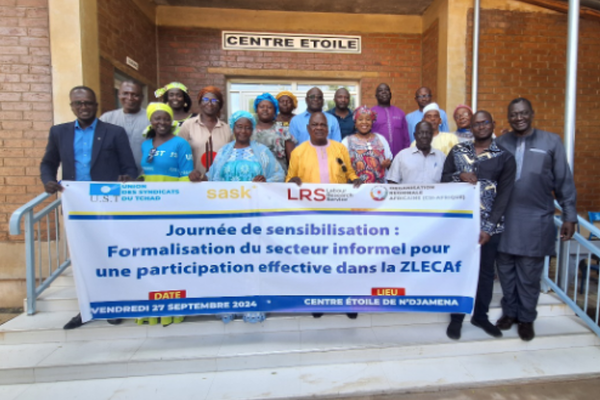
UST is also educating affiliates, particularly in agriculture and manufacturing sectors, using LRS as a resource base.
Knowledge and practical tools for worker power
LRS develops research and practical tools to support worker advocacy in new arenas.
In partnership with Active Shareholder, LRS created the Active ESG Index, a tool designed to help South African non-profits invest their reserves in socially responsible listed companies.
The index evaluates corporate performance across governance, remuneration, employment practices, corporate social investment and environmental impact.
The index uses publicly available data to provide a clear metric for comparing businesses within their specific sectors.
Pilot tests on major retailers like Shoprite and Woolworths reveal how executive pay gaps and environmental footprints influence a company’s final standing. Active shareholder has continued to use and refine this index as they vote at listed companies’ AGMs.
Ultimately, this framework serves as a secondary method for shareholder activism, allowing investors to influence corporate behaviour beyond traditional proxy voting.
“The ESG Index is evolving into a very useful tool that Active Shareholder can use to generate a snapshot of a company’s Ethical, Social, and Governance performance over the previous financial year, based on the company's reported actions in its Integrated Annual Report. The work done by the LRS in the initial stage of development was crucial to the development of this useful tool.”
— Rod Bulman, Voting Agent, Active Shareholder
Social dialogue and collective bargaining
The LRS supported Public Services International, the global union federation for workers in public services, by creating a comprehensive bargaining toolkit for trade unionists at the local level. The toolkit provides the strategies, knowledge, and skills necessary to engage in effective social dialogue and collective bargaining. The core message of this work is that public services cannot be sustainable or equitable unless the workers delivering them have secure employment, safety, and respect.
The toolkit takes a strong stance on the ownership of public services. Using solid waste management as a primary case study, we address the failures of privatisation, which often lead to higher costs, neglected poor areas, and precarious working conditions.
Unions have the arguments and tools to advocate for remunicipalisation — bringing services back under public control to ensure fair access.
Recognising that “decent work for all” must include the most vulnerable, the toolkit explicitly advocates for bridging the gap between formal unions and informal workers. It highlights how integrating informal waste workers (who often handle the bulk of recycling) into formal municipal systems leads to cleaner cities and dignified livelihoods. Connecting the issues of these workers to the wider Just Transition issues is an integral part of how we move forward. The workers are essential to combatting climate change, and positioning the workers and their concerns should be integral to any policy changes.
With this toolkit, we want to help trade unions to strengthen and entrench their position as credible role players who can influence policy, protect marginalized workers, and lead the path toward sustainability and environmental justice.

Positive influence out into the world
South African law now recognises equal parental leave rights for all primary caregivers. The next step is ensuring this ruling is reflected in our collective bargaining agreements and workplaces.
In October, the Constitutional Court handed down a landmark judgment declaring provisions of the Basic Conditions of Employment Act and the Unemployment Insurance Act unconstitutional in Van Wyk and Others v Minister of Employment and Labour. The Van Wyk’s, together with Sonke Gender Justice and the Commission for Gender Equality, filed the case in Johannesburg High Court in 2023.
LRS appeared as friends of the court. LRS showed how unequal parental leave provisions reinforce gender inequality in employment and perpetuate the undervaluation of care work. Drawing on our research and engagement with trade unions, we highlighted the importance of valuing the different identities of workers. This contribution builds on LRS’s broader work supporting equity bargaining in unions
“The ruling challenges the notion that caregiving is solely a woman's responsibility. When men choose to take parental leave, it shifts the perception of the leave itself and introduces a new perspective that adds value to it. The real challenge is ensuring the ruling translates into concrete action rather than simply remaining words on a page. Our collective bargaining agreements must also align with this decision.”
— Nina Benjamin, Leader, LRS Gender Equality Programme
LRS fundraising capacity
Sustaining an independent labour support organisation requires constant resource mobilisation. Over time, thehas built strong fundraising capabilities. We align fundraising with the priorities of the trade union movement in a changing world of work. We continue to cultivate and maintain relationships with partners. This capability has enabled LRS to sustain critical work that helps trade unions to prosper.
LRS communications and campaigns support capacity
"A continental free trade area requires a continental free trade union movement."

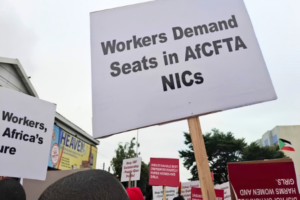
Trade unions seek inclusive and equitable implementation of the AfCFTA | Regional Capacity Development and Political Engagement Forum | June 2025, Nairobi
Trade unions have strengthened their online presence, influence and participation in trade discourse. They now articulate clearer positions and demands on the AfCFTA and speak with greater confidence on trade issues.
Campaigns are more structured. Advocacy tools support national and continental engagement. LRS produced videos featuring trade union leaders, youth and women calling for an AfCFTA that works for workers. Unions also practised rapid-response advocacy on trade and debt. Messaging and documenting change stories have become strategic union capabilities.
“One of the most useful and innovative elements of the LRS workshops was the focus on messaging. We often concentrate on political analysis but don’t spend enough time on how we communicate our message, whether to our members, bosses or government. LRS helped us clarify what matters most to workers regarding the AfCFTA and how to present it. COSATU was aligned and on point when we took our message to the global stage at Labour 20."
— Tanya van Meelis, Head of COSATU Policy Unit
Publications and tools:
- Inflation Monitor
- Bargaining Benchmarks
- Directors’ Fees Report
- Wage Bargaining Review
- Feminist Economic Justice Toolkit
- Facilitation Toolkit – Resources for facilitators and educators
- PSI toolkit
- Trade, Employment and Trade Unions in Africa – Some policy options
- Trade Union Informal Cross Border Trade Advocacy
- Industrialisation in Africa and the African Continental Free Trade Area (AfCFTA): Some policy options for trade unions
- Labour Provisions for the African Continental Free Trade Area (AfCFTA): Some Policy Options
- Just Transition And The African Continental Free Trade Area (AfCFTA): Some Policy Options For Trade Unions
- Leveraging the AfCFTA for the formalisation of informal cross-border trade in Africa: insights from Ghana. (International Journal of Labour Research, Volume 13, 2025)
- Wage calculator
- Resources for trade unions negotiating international trade
- Labour market dynamics in Southern Africa: South Africa
"Knowledge is too important to leave in the hands of the bosses."
— Gordon Young, Founder, Labour Research Service
In this series:
Identity | The collective ‘coming out’ of care workers in the Expanded Public Works Programme
Voice | How workers’ voice is shaping trade policy
Belonging | in the trade union
Sustainability | through programme development