The care economy is the total system of work paid and unpaid – that keeps people alive, healthy, educated and able to work and participate in society.
We think of roads and dams as essential infrastructure, but care infrastructure is what makes all of that possible. Society cannot function without care work.
Unpaid care work mostly done by women is invisible in Gross Domestic Product (GDP). Because it is not paid it is not counted and not prioritised in policy and budgets. Policymakers routinely assume there is no cost attached to care work, and that women are always available to absorb it.
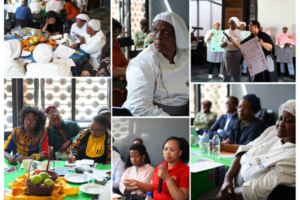
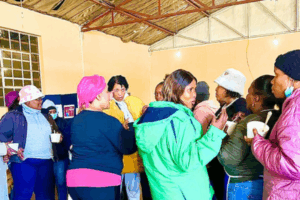
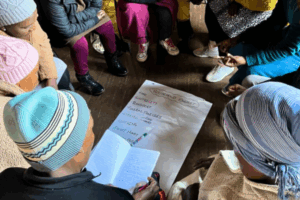
LRS operates at the intersection of research, worker education and policy engagement. We focus on applied, participatory and action research that strengthens the ability of workers to investigate their own conditions, generate evidence and with this evidence shape policy outcomes. Over the past four years, we have walked alongside Volunteer Food Handlers in Gauteng, helping them recognise the power they hold in schools and in society at large. We have supported food handlers to build identity, voice and capacity to advocate for decent work in the National School Nutrition Programme, which is one of the social sectors under the Expanded Public Works Programme.
Here I use various themes to assess whether public employment in the care economy opens up new possibilities, or whether it reproduces existing inequalities. Each theme addresses the transformative potential and the risk.
What role can public employment programmes play in transforming the value placed on care work OR will it reinforce gender inequalities?
The case of Volunteer Food Handlers in the National School Nutrition Programme
Who are the Volunteer Food Handlers
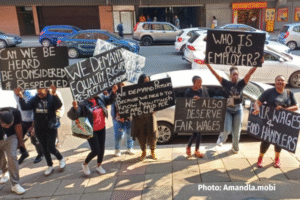
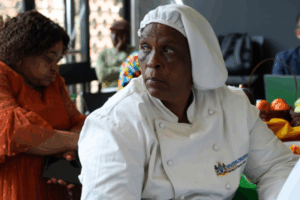
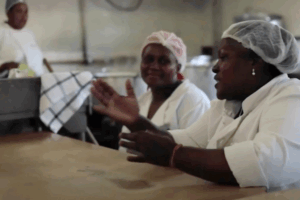
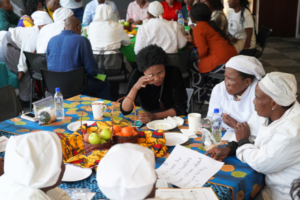
Volunteer Food Handlers are 60,000 overwhelmingly women care workers who prepare daily meals for more than 9 million learners in the National School Nutrition Programme.
The National School Nutrition Programme depends entirely on women’s care work, while simultaneously denying the women who carry out the work recognition, value, and rights.
Volunteer Food Handlers carry out the core operational work of the National School Nutrition Programme, cooking and meal preparation for up to 1000 learners in a school, coordination, and safety practices. Schools may appoint a teacher as a coordinator, but it is the Volunteer Food Handlers who sustain the daily functioning of the National School Nutrition Programme, drawing on their unpaid skills developed in the home, community knowledge and emotional labour.
Volunteer Food Handlers regularly report “making do” — working around broken stoves, missing utensils, and unreliable food supplies. This making do is weaponised against women where their care and commitment are used as free resources.
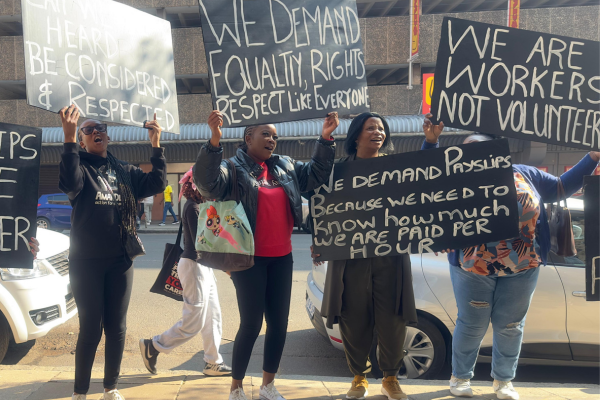
The term volunteer strips Volunteer Food Handlers of worker status and disguises the professionalism of their labour. In 2026, Volunteer Food Handlers earn R15.83 per hour lower than the Extended Public Works Programme rate. The rate is not consistent across provinces or even districts. This systematic underpayment reflects a broader patriarchal logic: when women’s care work is essential, the state still treats it as low-cost, low-skill, and infinitely expandable.
Contracts are not standardised and are inconsistently implemented across provinces. Volunteer Food Handlers report signing contracts but not receiving copies. This is a structural feature of feminised work, where women’s labour is used but not recognised. Many women accept the work out of “trust in schools and excitement about the opportunity”, not because the conditions are fair. Volunteer Food Handlers also report an emotional and moral commitment to being “good mothers to the children in the school”. The state leverages this socially constructed expectations of women’s selflessness, care and community responsibility to secure essential labour at very low cost.
Care as essential social infrastructure: What message does it send when essential care roles are unpaid or poorly paid?
Transformative potential
The National School Nutrition Programme provides daily nutrition to millions of learners whose education, health, and cognitive development relies on learners eating healthy food. Food handlers perform essential work that sustains the development outcomes of the entire school system.
Risk of entrenching inequality
Naming the work “voluntary” and paying a stipend signals that the state views this critical labour as low-value. Calling food handlers “volunteers” obscures the professional nature of the work.
The gendered division of labour: Does the National School Nutrition Programme challenge or reproduce the idea that care is “women’s work”?
Transformative potential
Public programmes can formalise feminised labour and turn so-called “women’s work” into recognised public employment.
There are clear pathways to professionalisation through food safety training, nutrition qualifications, and school nutrition careers. Volunteer Food Handlers are also uniquely placed to bridge school gardens and community food production — connecting what is grown to what is cooked.
Risk of entrenching inequality
Volunteer Food Handlers are overwhelmingly women, reinforcing the stereotype that cooking and feeding are natural female roles. Using women’s unpaid household skills to subsidise public service delivery at extremely low cost is a structural problem, even as the National School Nutrition Programme is hailed as a government flagship.
Devaluation of care work: Does the National School Nutrition Programme elevate care work or keep it economically and socially invisible?
Transformative potential
Public employment can attach wages, protections, and standards to care work that has historically been unpaid.
Government recognition has the potential to shift societal attitudes about the value of care.
Risk of entrenching inequality
When stipends are low and irregular, it reinforces the belief that care work is worth very little.
The low compensation masks the high economic and social value of the labour being delivered.
Precarity vs. decent work in public care roles: Does the National School Nutrition Programme provide decent work or reproduce the precarity that defines feminised labour?
Transformative potential
Public programmes could provide stable employment, training, career pathways, and social protection for women who currently lack these things.
Risk of entrenching inequality
Food handlers often work without proper contracts, benefits, or job security, reproducing the precarity that defines feminised labour markets.
Lack of labour rights entrenches a two-tier labour system: formal educators vs. informalised women carers.
Recognition of skill and professionalism: Is Volunteer Food Handlers work framed as skilled, or as a natural extension of domestic roles?
Transformative potential
The National School Nutrition Programme requires skill: food safety, bulk meal preparation, nutritional awareness, child protection, time management, and teamwork. Recognising skill sets challenges the myth that care work is “unskilled.”
Risk of entrenching inequality
When women’s skills are not certified, accredited, or formally recognised, care work remains undervalued and invisible. It keeps women trapped in low-wage, low-status roles.
Worker voice, agency, and participation: Are Volunteer Food Handlers treated as partners in the National School Nutrition Programme, or as volunteers with no voice?
Transformative
Involving Volunteer Food Handlers in planning, monitoring, and evaluation strengthens worker agency and centres their expertise. Participatory approaches can democratise public service delivery.
Risk of entrenching inequality
When Volunteer Food Handlers don’t have a say in decision-making, scheduling, or working conditions, the programme reinforces traditional power hierarchies — teachers and principals above women care workers.
Does the care infrastructure in the school reflect dignity and safe and healthy conditions for preparing meals for the learners, or neglect of both the health and safety of Volunteer Food Handlers and learners in school?
Transformative potential
Investment in kitchens, equipment, safety measures, and training improves working conditions and signals genuine respect for care labour.
Risk of entrenching inequality
Poor infrastructure forces women to work under unsafe, unhygienic, or physically demanding conditions. Weak infrastructure reflects and reproduces the low value placed on care labour.
The role of the state in valuing or exploiting care work: Is the state investing in care or relying on women’s poorly paid work to fill gaps?
Transformative potential
The state can model what a caring economy looks like: stable care jobs, training, accreditation, and professionalisation.
Risk of entrenching inequality
The state uses cheap feminised labour to meet essential social needs without investing in proper staffing or wages.Without reform, public programmes risk becoming a form of state-sponsored gender inequality.
Care work as a pathway to decent work and dignity or to cycles of poverty: Does the National School Nutrition Programme build economic justice, or reproduce women’s marginalisation?
Transformative potential
Public employment could offer skills, recognition, stable income, and pathways out of poverty, for example, the value of a certificate and career guidance support.
Risk of entrenching inequality
If the programme remains low-paid, informal, and precarious, it traps women in cycles of poverty while delivering enormous value to society.
The capabilities of Volunteer Food Handlers
- Specialised practical knowledge of nutrition and food safety, developed through daily responsibility for feeding large numbers of learners.
- Skills in food logistics, kitchen operations, implementing safety standards, and managing working relationships.
- Coordination, managing scarce resources and dealing with shortages, negotiating with school staff, and supporting each other.
- These capabilities create potential roles that Volunteer Food Handlers can transition, including: Community nutrition activists and educators; Monitors of school nutrition quality; Food safety practitioners; Agroecology educators, and small enterprise owners.
Broader research context
This discussion sits within a broader body of research on Public Employment Programmes in South Africa. Recent work published by University of Cape Town’s Southern Africa Labour and Development Research Unit (SALDRU) challenges the oversimplified idea that public employment programmes can act as direct springboards from unemployment into sustainable jobs for most participants.
The labour market added approximately 5.5 million people between 2014 and 2024, but formal sector jobs grew by only around 700,000 in the same period. The SALDRU report argues that progress for most participants is more incremental — a set of stairs rather than a single leap.
Public employment can support people in building livelihood portfolios that combine wage income with other income-generating activities, even when sustainable formal employment remains out of reach.
For the care economy specifically, this raises an important additional dimension: the question is not only whether Volunteer Food Handlers gain skills or access the labour market, but whether public employment reinforces or begins to dismantle the gendered structures that make care work chronically undervalued in the first place.
RELATED ARTICLES
Valuing care work: What are the prospects for women in the National School Nutrition Programme?
What does the national budget say about how the government values care work?