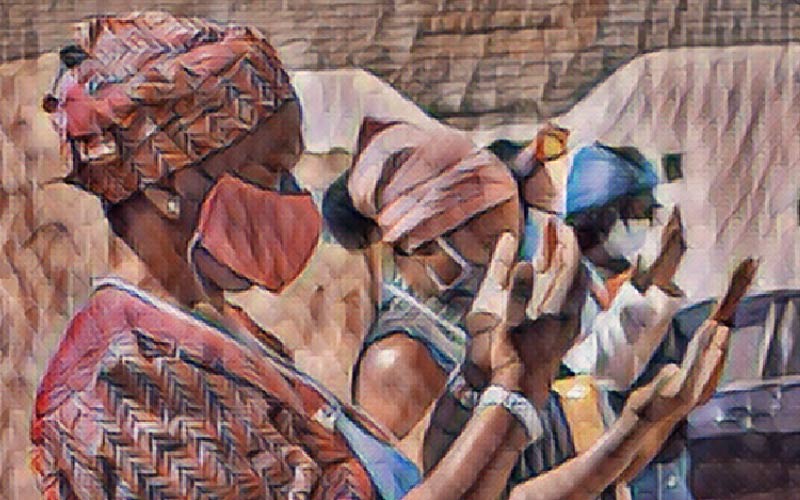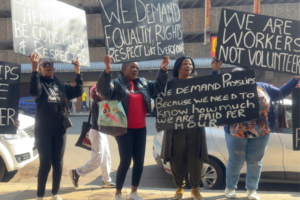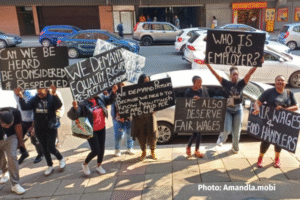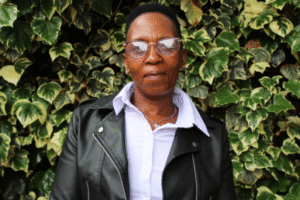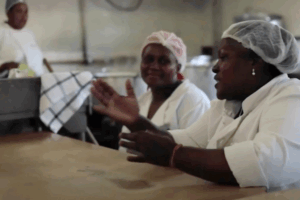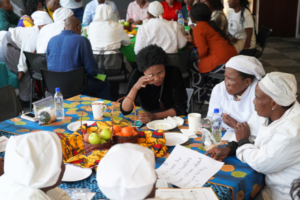
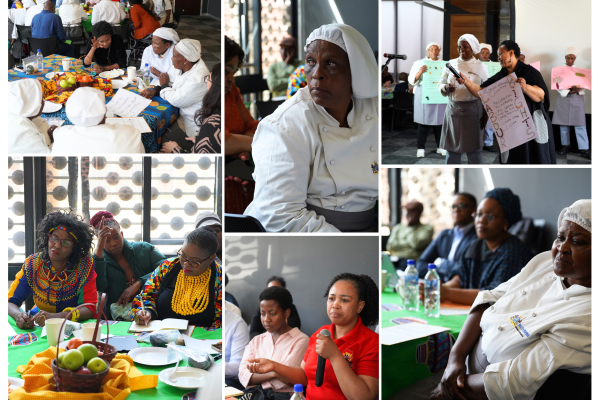
In 2024, the LRS hosted the colloquium “Food in schools is a social justice issue”, in partnership with Food Handlers advocating for decent work within the National School Nutrition Programme (NSNP). The colloquium brought together role players committed to strengthening the (NSNP) and ensuring the rights of volunteer food handlers as workers. Nthakoana Maema, Chief Executive Officer of Oribi reflects on her experience at the colloquium and the impact in continues to have in her work. Oribi is an impact incubator that promotes social innovation by supporting entrepreneurs to build sustainable and alternative ecosystems.
When I left the colloquium, I remember feeling unsettled, expanded, inspired, but also enraged, which means that I was fully immersed and I was fully applying myself in it. This kind of rage gives me energy to want to do something about it, to get into action as a person who is oriented towards innovation.
It was quite special already, the venue, being at the Old Women’s Prison. Doing the tour, understanding what people were going through in terms of food security (my lens) at those times, when the prison was still active, is already in itself, a pain. I feel extra connection to events where place is important. The National School Nutrition Programme (NSNP), even though it’s not ideal, is a very important social policy feeding nine million children who don’t have access to food. It is in a way, de-commodifying food for those families so that their children can have at least one meal in a day.
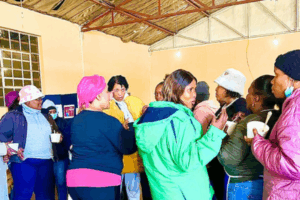
What left me enraged was really hearing the Food Handler’s stories – unedited or unintellectualized – hearing them as they’re experiencing it, with the emotions they’re feeling, once again, that reproduction and social reproduction work, remains unrecognised and undervalued. That these women are doing really critical structural work under deplorable conditions, like cooking, cleaning, sustaining school kitchens without protective equipment, or job security, or space security. Some of the ladies sharing how bad the physical conditions of the infrastructure of school kitchen can be, without even clarity of who their employer is. And the woman is talking about pride, how she’s bringing her own equipment from her house. So they’re meeting a gap that the government is not able to meet, to keep the program running. Then they are also relationally connected in the school. Example, I heard stories about how teachers send dysregulated children to talk to Bo’ mme in the kitchen. So they’re also playing the role of an auxiliary social worker where they’re helping regulate children for the school. When children are writing exams, they’re the ones who are encouraging them. When children are feeling low, they’re the ones who are encouraging them. So they’re part of the emotional fabric of the school. Why it feels like so part of me and indivisible, is because the intentional design of it is very clear.
Like starting the day with a Tai Chi exercise, which is not something that you normally do in a policy space or a space like a programmatic space. Nosipho Twala, LRS Gender Researcher and Facilitator, did the Tai Chi very well to link that movement to the movement of food and sun and elements and nutrition which was really great. And the provocations from the team where they were just talking from the heart and giving context, but not like academics doing PowerPoints.
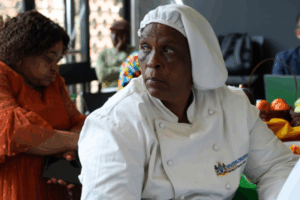
At some point, we had porridge for breakfast. We went to the kitchen, which had been owned by the Food Handlers. They’re the ones serving us, wearing a uniform with pride, showing us the menus that they had redeveloped with the Gauteng Province, speaking to us. That’s a lot about it, but more so about the importance of the food, and then how this is the reality of the children that they’re working with, and what they would love to see more of.
So that was an amazing, symbolic way, and the learners were in the room connecting us with them, and their work.
Also, instead of the Food Handlers being like academic case studies where academics are around to legitimise their voices, they were the professionals. They and the children were the ones who were presenting to us. The children were telling us their story and their connection with the three sisters, why it’s important to them and the fact that they’d learned that from the FHs. That was amazing, meaning again that the women are not only acting as volunteers, Food Handlers, but they’re also nutritional educators, and they’re moral models to those young children.
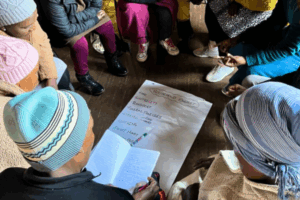
The way they told their stories didn’t feel contrived. They had their own posters – very simple, creative, expressed in their language. It was a very humane setup for them to communicate and talk to us. This, I think is a feminist and decolonial way of convening and centring care, embodiment, and relational learning.
In the end, it was about reorienting my own practice. Highlighting more and more how we cannot have policy conversations or programmatic conversations without the voices and the bodies of the everyday labour that makes those systems work. They are an embodied part of me now. I carry them with me everywhere, so whatever space that I am in, whether a policy conversation around agroecology, or a project meeting with the city of Cape Town or a food system dialogue where I am a panellist or a participant, in those spaces that I present, I make visible the Food Handlers.
Most of the time we might be talking about farm workers, small scale farmers, informal food traders, people that are responsible for food flow, but the NSNP although a state program, is being sustained by these women who are Food Handlers in it. Yet you never hear anything about them in these spaces.
Then they’re also embedded in community. We talk about how we should recognise food system heroes as well, as invisible anchors of national food security. So there’s potential with these women to help them transition into a solidarity economy or into social enterprises, so they can generate a sustainable livelihood.
It has continued to inform my sense of justice in the food system and to keep naming these women that are responsible.
I was left with the question what is next? Yes, social dividend is necessary and social protection is important. Better pay and better security of their pay is important. Certification of their skills is important because it gives them access to new jobs and other places where they can do food handling as a job. But on the next level, how can we reshape the work that they’re already doing into something that is a sustainable enterprise that embraces co-operative principles which they’re already doing and how does that get supported and how does that get linked to the food flows? How does that get linked to the urban growers – the informal food traders – the ECDs -the spaza shops – the retailers supply chain? How does that work get linked and supported as part of an embedded security solution? That has income generation in a positive way, that has ecological regeneration in a positive way?
In my current research I’m looking at invisible economies of care and how women’s social reproduction and adaptive labour contributes in food systems and to what extent development finance recognises it. I want to understand what that social reproduction labour looks like, what adaptive labour looks like, how do we consider it as value in terms of economic work and climate adaptation work. And instead of just looking at informal food traders, community kitchens and urban food, I would like to include Food Handlers as a case study in knowledge production, because although it’s a state program, it’s largely informal in the way that the women are experiencing it. So how we start to think about feminist and decolonial ways that development finance, climate finance can resource and sustain this work.