
In April 2025, thousands of community health workers (CHWs) in the Eastern Cape employed under the South Africa’s Extended Public Works Programme suddenly stopped receiving their stipends. What was initially described as a minor administrative delay stretched into three months of uncertainty. At the start of the year, CHWs had signed new contracts with a modest increase from R4 800 to R5 288, a raise many described as inadequate but necessary. However, the money never came. Families plunged into financial crisis with their food security threatened and dignity eroded. Their insurance policies lapsed, their children’s school fees went unpaid, and many workers were forced to borrow money just to survive. Frustrated by the issue, CHWs organised themselves into persistent action, strengthening a movement rooted in solidarity to demand the wages they were owed.
CHWs fall under the Social Sector of theExtended Public Works Programme (EPWP) and are contracted through the Department of Health to provide community-based primary healthcare services. Their work includes household visits, health promotion, disease prevention, counselling, basic care, and referrals to clinics and hospitals. CHWs receive a stipend set nationally, with conditions determined by EPWP guidelines. Currently, they are contracted either directly by the health department under provincial programmes, where they receive standardised stipends and contracts, or through NGOs and implementing partners, where conditions vary widely and stipends are often lower and less secure. Although they are not recognised as permanent employees with social security benefits, CHWs often work full-time hours and form an essential part of South Africa’s public health system.
Across South Africa, CHWs typically earn stipends ranging from about R2 500 per month in some programmes to R5 288 under the health department’s benchmark rate. At the start of 2025, CHWs in the Eastern Cape signed new contracts increasing their stipend to R5 288 per month.
Though the increase was minimal and unsatisfactory, workers were left with no choice but to sign their contracts and continue fulfilling their contractual obligations as care workers. In Buffalo City, the stipend delays began in April 2025, shortly after CHWs signed their new contracts.
For CHWs on the ground, these structural issues quickly turned into deeply personal struggles. Bulelwa Faltein, a CHW and member of the South African Care Workers’ Forum (SACWF) in the Eastern Cape, felt the devastating impact of not receiving her stipend. Like many others, she has worked as a community-based health worker for more than 20 years, supporting her family and relying on the stipend to make ends meet. The department’s withholding of payments left her frustrated and anxious.

Bulelwa Faltein, Community Health Worker and member of the South African Care Workers Forum
“As someone who is working, you have responsibilities. But our budgets collapsed. We borrowed from friends and family, but it was humiliating to survive on handouts."
Bulelwa, along with other CHWs, took it upon themselves to visit the Human Resources (HR) departments at their local DoH offices to make inquiries about the defaulted payments. Officials in the department told them that the delay was due to a minor administrative discrepancy and more specifically, that the names of those who were affected did not appear in the department’s list of CHW stipend beneficiaries. To this they promised that the issue would soon be resolved. However, the delay stretched into months of uncertainty. CHWs continued to visit the local offices asking questions and demanding answers.
“We were promised a one- or two-week delay. But when April ended, nobody had been paid. By May, only a few CHWs received stipends, and by June, many of us were still unpaid.”
Bulelwa, Community Health Worker
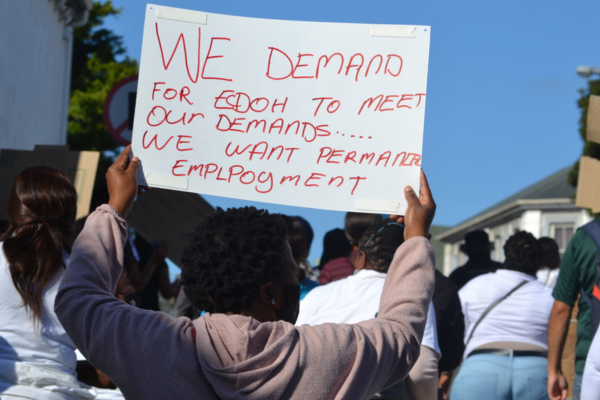
At the heart of this struggle was the South African Care Workers Forum (SACWF), a grassroots movement built by Care Workers and for Care Workers, guided by principles of non-violence, self-reliance, and alliance-building. When official explanations failed to come, CHWs mobilised. SACWF issued media statements, wrote letters, and personally visited HR offices across districts. Their struggle reached a turning point when care workers decided to take their demands directly to the provincial health department.
“We went to the MEC’s office and said we would not leave until they understood,” Bulelwa explains. They confronted senior officials, highlighting the absurdity of working without pay while their families went hungry. Even with their growing frustrations, the CHWs were guided by SACWF’s non-violent approach, opting to sing struggle songs, speak plainly about their pain, and insist on accountability from the provincial officials. One of the concerns CHWs raised was that, once they got paid, their stipends would be taxed. This had happened before in previous instances of a similar nature. Eventually, after months of pressure, the payments were authorised and released without tax at the end of June 2025, bringing the struggle to an end. When they received their stipends and were back-paid for the months in which they went without stipends, CHWs felt relieved and felt positive. Their relief was short-lived because, before CHWs could settle back into a normal rhythm, the Department of Health announced that some CHWs had been “overpaid” and would need to refund the overpaid amounts.
In reality, the overpayment was the reflection of a contractually agreed stipend increase from R4 800 of 2024 to R5 288 in 2025. In response to this, SACWF stood firm, citing Section 38(2)(b) of the Public Service Act to challenge the pending deductions.
“We could not accept that. Our contracts clearly stated R5 288. There was no overpayment. To claw it back would be unlawful.”
- Bulelwa
Eventually, the DOH retracted their request for CHWs to refund them.
Although CHWs are formally organised under unions such as the National Education, Health and Allied Workers’ Union (NEHAWU), Bulelwa describes their role during the crisis as disappointing:
“They kept saying they were engaging the department, but we saw no results. In the end, it was us, the care workers, who went to the offices, demanded answers, and secured our stipends,” says Bulelwa.
SACWF’s determined actions earned newfound respect from trade unions. For a forum once side-lined by trade unions and misunderstood by other CHWs, this recognition marked a turning point.
“It proved that nothing about us, without us, is possible. We have the power to fight for ourselves.”
The stipend battle strengthened SACWF’s identity and expanded its membership in the Eastern Cape. Many CHWs who previously saw SACWF as competing with unions began to understand its distinct role as an organisation rooted in truth-telling, self-representation, and radical solidarity.
“In the past, some thought we were copying unions. But now they see we are something different. We are care workers standing for care workers,” Bulelwa explains.
Reflecting on the struggle, Bulelwa describes SACWF as evolving into a feminist organisation that embodies radical love and solidarity.
“We didn’t use violence. We stood firm, told the truth, and reminded them we are human beings with families. That humanity broke through the arrogance of officials.”
For SACWF, the stipend struggle was not only about wages, it was about dignity, recognition, and power. It also laid the groundwork for tackling broader issues such as permanent employment, social protection, recognition of prior learning, and fair labour conditions for CHWs in the work that they do.
As Bulelwa concludes, “This was just one step forward. We cannot achieve everything at once, but we are moving, and we are growing. Every struggle makes us stronger.”
RELATED ARTICLES
Community Health Workers: “Nothing about us without us”
Our care stories: “We are essential, not invisible”
Women care workers organise for decent work