
Trade unions know that organising workers is rarely as simple as signing up members. Many workers are employed on insecure contracts. Others are labelled as volunteers, outsourced through NGOs, or scattered across different employers and workplaces. They often face different conditions, making it difficult to see their common interests.
The challenge is particularly visible in public care programmes. Community Health Workers, Food Handlers in the National School Nutrition Programme, and Early Childhood Development (ECD) Practitioners perform essential services but are treated as volunteers, temporary workers or low-skilled labour.
Since January 2025 the LRS has worked with the three groups of care workers located in the social sector of the Expanded Public Works Programme (EPWP). Through feminist popular education, worker-led research and advocacy, LRS helped create spaces where workers can reflect on their experiences and build a collective voice. We propose that care workers in the EPWP are workers deserving fair pay and decent work. We challenge the idea that care work is the “natural” responsibility of women.
Working with the South African Care Workers Forum (SACWF), the Concerned Food Handlers Forum of Gauteng and the South African Democratic Teachers’ Union organising ECD Practitioners, we are supporting cross-sectoral organising, development of worker-led evidence and a shared national platform capable of advocating for fair wages and decent work in the care economy.
The care workers’ experience offers practical insights for trade unions organising workers in vulnerable and precarious work.
1. Recognition begins with self-valuing
Campaigns tend to focus on convincing employers, governments or the public that workers deserve recognition. But recognition begins much closer to home.
Many care workers initially described themselves as “just volunteers”, or as having come from nowhere and entered their roles without skills. Through story circles, reflection and competency mapping, they began identifying the knowledge, judgement and responsibility required in their daily work.
Community Health Workers named the counselling, screening, referral, household mapping and psychosocial support they carry out every day. Food Handlers named the expertise required to prepare safe meals for thousands of learners. ECD Practitioners described the emotional, developmental and educational labour they provide long before children enter formal schooling.
As workers recognised the value of their own labour, they became more confident speaking publicly, challenging unfair treatment and organising collectively.
Workers need opportunities to recognise themselves as skilled workers before they can demand recognition from employers, government or society.
2. Legal education must be connected to organising
Court victories, labour legislation and collective agreements create opportunities, but they do not organise workers on their own.
The discussion of the NEHAWU court ruling on Community Health Workers showed this clearly. The judgment created as much confusion as opportunity. Workers needed space to understand what it meant, where it applied, what gaps remained and how they could use it to strengthen their organising.
The food handler legal process worked the other way round. Workers identified the documents and facts needed to test employment status: contracts, attendance registers, proof of payment, instructions from school or departmental officials, working hours and supervision. Their daily experience became the evidence.
Legal education therefore became part of political education. Instead of simply explaining the law, LRS worked with workers to connect legal developments to their lived experiences, collective demands and organising strategies. This helped workers see the law not as something delivered by experts, but as one tool among many in the struggle for decent work.
Workers organise around what the law makes possible, not around what the law says.
3. Organisational principles become real in moments of crisis
Organising rarely happens under ideal conditions.
Workers faced delayed payments, uncertainty over employment, changing government policies and insecurity in their workplaces. These moments test organisations, revealing whether organising principles can withstand pressure.
Community Health Workers in the Eastern Cape responded to unpaid stipends by staying calm, building relationships, refusing to depend on established unions to speak for them, and insisting on direct engagement with the MEC’s office until the stipends were paid. Workers described acting with hope, determination, pride and connection. Through persistence, dignity and non-violent action they strengthened the legitimacy of their demands, built support from allies, protected workers from retaliation, and showed that care workers can lead their own struggles while drawing on wider solidarity. Values such as transparency, accountability and democratic participation strengthened organising practice during a crisis.
Recruiting and organising principles are visible and strengthened during moments of crisis.
4. Messages must connect care, skill and justice
Experienced Community Health Workers have been excluded from absorption into the Department of Health because they do not hold a matric certificate, after years of doing the work.
Naming the full range of what workers do challenges the narrow idea that formal schooling is the only valid measure of readiness for permanent employment. Workers demand a supported Recognition of Prior Learning process.
A message that names only the care invites sympathy. A message that names the skill, the injustice and demand invites an argument the State has to answer.
A strong message connects the work, skill, the injustice and demand.
5. Asking "why" strengthens advocacy stories
Workers begin by describing what is wrong. There are no gloves. Stipends are delayed. Kitchens are unsafe. There is no pension. These are important observations, but effective organising asks a second question: why does this matter?
No gloves become a story about infection control and worker safety. Delayed stipends become a story about household survival. Unsafe kitchens become a story about children’s nutrition and education. Lack of recognition becomes a story about whether the primary healthcare system holds together at all.
The “why” is what moves the people you are trying to reach beyond sympathy, towards understanding, solidarity and action.
The strongest organising stories describe why problems matter.
6. Rituals, symbols and stories help create a shared care worker identity
Building solidarity across different occupations requires workers to see themselves as part of something bigger than their own workplace or profession.
We used the three-legged pot as a symbol of the care economy. Community Health Workers, Food Handlers and ECD Practitioners are the three legs supporting one pot. Without one leg, the whole pot becomes unstable.
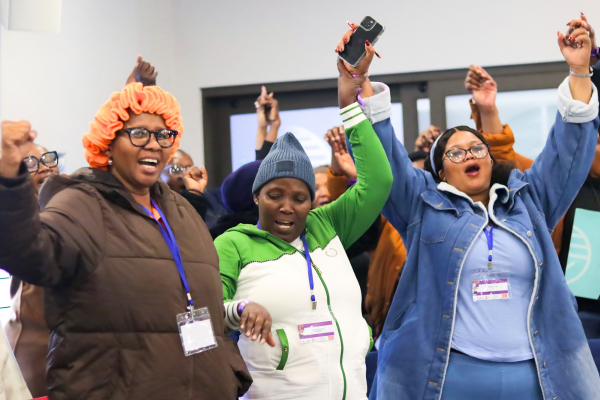
At the first Care Workers’ Convergence in October 2025, the gift exchange, the sky canvas, story circles and sector reflections helped workers see that although their jobs differ, they have similar achievements, challenges and dreams, and that they are part of one care system. The Care Workers’ Day poster design process became a political education process.
Workers began to see themselves not only as Community Health Workers, Food Handlers and ECD Practitioners, but as care workers with a shared stake in transforming public care work.
Shared identity grows when workers can see themselves reflected in common stories, symbols and experiences.
7. Symbols become powerful when workers use them in public action
On Care Workers’ Day, workers made visible their labour by carrying the tools of their trade into public spaces. In Evaton, Gauteng, Food Handlers marched through the community and children followed them, because they recognised the women who feed them at school.
8. Movements need a rhythm
Campaigns risk losing momentum once the march is over. The challenge is turning moments of mobilisation into habits of organising.
The first Care Workers Convergence last year was where workers began to recognise one another across sectors. Care Workers Day on 7 February 2026 carried that identity into communities through marches, dialogues, performances and public conversations.
The steady rhythm between activities sustained the momentum. A monthly electronic care workers’ calendar profiles a slogan, a right and a story. Posters circulate campaign messages. Regular online and offline meetings sustains sharing, learning and organising. WhatsApp groups connect care workers across provinces. Published care stories keep care work visible in public conversation.
Rather than treating advocacy as a series of isolated campaigns, the movement created an ongoing cycle of reflection, learning and action. Each activity reinforced the next, helping workers stay connected even when they were hundreds of kilometres apart.
9. Stories are practical organising tools and can become public evidence
At the second Care Workers Convergence in June 2026, care workers walked through their stories exhibition and read each story as data.
Through collective reflection they identified patterns across sectors and connected individual struggles to wider questions about labour rights, public services and public investment. Instead of asking what happened to me, they began asking what this tells us about the system.
That shift produced evidence, with care workers participating in the People’s Inquiry into care work in public programmes, shaping the People’s Ten-Point Budget Plan for 2027 and strengthening shared demands for a national care infrastructure.
Care workers are not only sources of information. They are producers of knowledge and analysts of their own conditions.
Workers are producers of knowledge and must be recognised as partners in developing solutions.
10. Feminist popular education methods are impactful
LRS uses a feminist popular education approach that starts from workers’ lived experience and creates the conditions for collective reflection, analysis and action.
Metaphors communicate complex political analysis. The four-pots framework of home, community, country and global introduced in the second Care Workers Convergence let workers trace where care happens, who does it, who benefits from it, and how unpaid and underpaid care in the home shapes the devaluing of paid care work in public programmes. Concepts such as the deputy mother, the reserve army of care workers, the global care chain and care as infrastructure gave workers language to explain why women are expected to absorb crises without recognition or pay.
Tai chi, water rituals, candle-lighting, poster galleries, collage-making, storytelling circles, role plays, songs, food, visual timelines, budget games and WhatsApp voice notes created emotional safety, joy, memory and participation. The head, the heart and the feet method offers holistic approach to learning and development to inspire critical reflection and action.
As workers grow in confidence, they became more willing to facilitate discussions, speak publicly, analyse policy and take on leadership roles in their organisations and communities. Political education becomes part of organising.
Political education should connect ideas to lived experience, collective analysis and action.
Building movements that last
These lessons speak to a much wider challenge facing the labour movement: how to build worker power among workers whose employment has been fragmented, undervalued and made invisible. Building an effective workers’ movement means creating the conditions for workers to recognise the value of their own labour, connecting individual experiences to structural problems, building solidarity across sectors, sustaining momentum between campaigns, and treating workers as producers of knowledge capable of shaping policy and public debate.
Also read:
- The people’s inquiry into care work in public programmes
- Why care workers refuse to be called volunteers
- Thinking about recruitment and organising