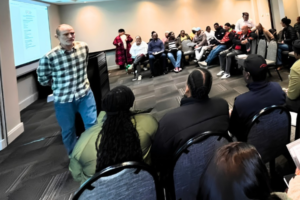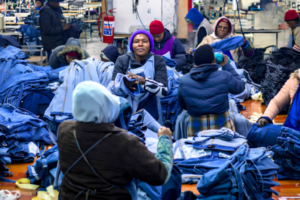

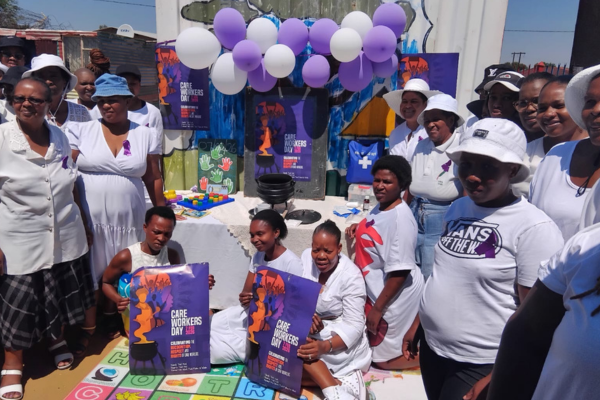
On 7 February 2026, care workers across South Africa gathered to recognise and celebrate themselves and to make visible the labour that has long sustained society without recognition. In celebrating, they confronted a long-entrenched contradiction between the value of care work and the conditions under which it is performed. What was built through dialogue at the Care Workers Convergence in 2025 translated into practice: a shared identity rooted in care, solidarity, and collective struggle, and a day of recognition and commemoration for care work. Across churches, parks, schools, and public spaces, Community Health Workers, Early Childhood Development practitioners, and Food Handlers visibilised the labour that sustains families, communities, and the nation itself.
This was the first-ever Care Workers Day, not merely symbolic, but a public declaration that care workers are organising as a unified force. In asserting a collective vision for decent work, they began to build community support, strengthen leadership, and establish a more coherent public voice.
South Africa’s social and economic system depends on the existence of care work, yet it continues to treat care workers, the very people who provide it, as disposable. This pattern is not new. Rather, it is rooted in a long history of racialised and gendered labour systems that have systematically extracted care work while excluding it from formal recognition and economic value. Care workers ensure that children are fed, that communities receive basic healthcare, and that early learning and development can be possible. This is work that carries people through the most vulnerable stages of their lives and holds together systems that would otherwise collapse. Yet, as has been consistently shown, this work is systematically undervalued, underpaid, and often treated as an extension of women’s unpaid labour rather than as skilled and essential work.
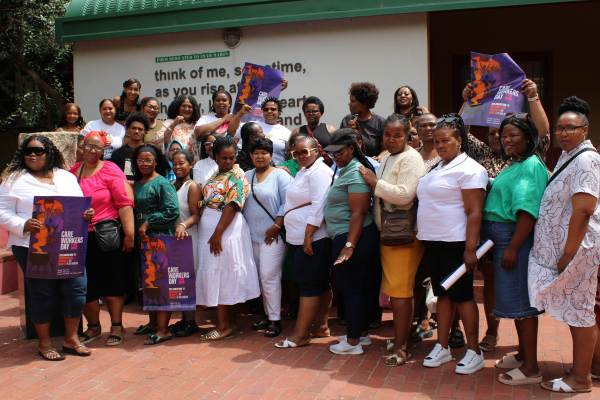
Despite supporting over 9 million learners, 2.5 million children, and more than 30 million community members, care workers in South Africa’s Extended Public Works Programme remain without decent work protections. Their roles may be organised across different sectors, but in practice they form a continuous chain of care that spans from early childhood through to adulthood and old age. Care Workers Day made that connection visible.

In society, care work is rarely spoken about as actual work, but rather as a self-evident occurrence or something natural, instinctive, informal, or even as an expectation. However, according to the ILO, care work refers to the wide range of activities required to meet the physical, psychological, and emotional needs of people across the life cycle. This includes both direct care and indirect care and paid and unpaid care work. Practically, these forms of care are inseparable and often overlap with one another.
Paid care work takes place within formal or semi-formal systems, schools, clinics, households, and community programmes, where workers receive wages or stipends, however inadequate. Unpaid care work, on the other hand, takes place primarily within households and communities, where care is expected but not compensated. The distinction is not just technical, it is political, because in South Africa women disproportionately bear the burden of both paid and unpaid care work. Studies show that women in sub-Saharan Africa spend three to three-and-a-half times more time on unpaid care work than men and boys.
This imbalance shapes who is able to enter the labour market, who remains trapped in precarious work, and whose labour is taken for granted. It has become increasingly clear that South Africa’s care economy depends on treating paid care work as if it were unpaid. For example, care workers operating within the EPWP are formally part of a paid systems, yet their conditions often mirror unpaid work with low wages, low protections, and an expectation of service that overrides recognition.
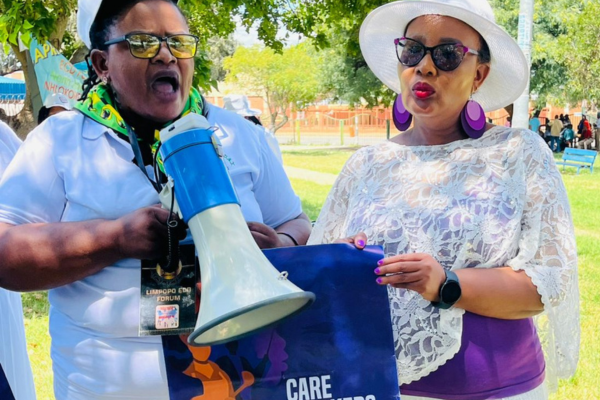
In this context Care Workers Day was not only about visibility but about challenging this blurred boundary while advocating for all care work to be recognised as skilled, essential work, deserving of the utmost dignity.
The foundations for Care Workers Day were laid during the 2025 Care Workers Convergence, where workers began to understand themselves as part of one ecosystem. This understanding was carefully captured in the metaphor of the three-legged pot (representing the three sectors of ECD practitioners, CHWs and FHs), which stands as a symbol of stability, shared responsibility, and survival. The pot metaphor was put into practice while preparing for and executing activities on the day. Across provinces, care workers intentionally created spaces that reflected their unity.

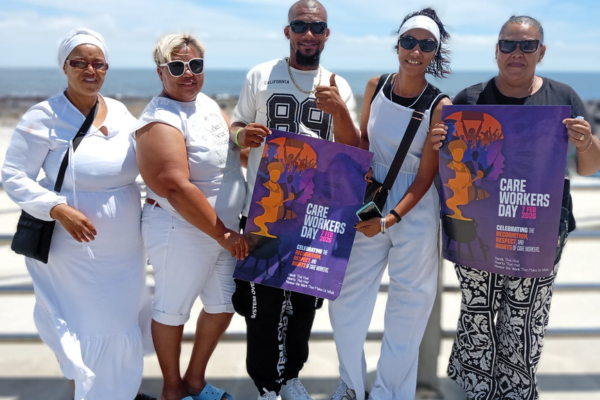
In the Free State, the day extended into a children’s home for those living with disabilities, recognising care in its fullest sense. In the Western Cape, a public demonstration created visibility and opened conversations with communities who had never before encountered the concept of care workers as a collective. In Limpopo, ECD practitioners used performance, storytelling, and dialogue to articulate the meaning of the day and the work behind it.
What stood out across all provinces was not just what was achieved, but how it was achieved. Care Workers Day was organised with limited resources, short mobilisation timelines, vast geographic distances, and, in some cases, outright resistance from allied groups. For example, in the Northern Cape, organisers travelled across large distances to distribute posters, ensuring that even those who could not attend would still be included in the message. In the Eastern Cape, mobilisation extended to streets, malls, and intersections, where care workers directly engaged communities to build participation. Even where turnout was lower than expected, the work of engagement continued through conversations, social media engagement, and community networks.
A recurring challenge across provinces was the weakening of solidarity where some care workers (CHWs) who had been absorbed into permanent roles while others remained in employed precarious conditions. In many cases, those who had secured employment disengaged from collective organising efforts presumably out of the fear of association. It became clearer that the system actively fragments care workers which in turn impacts their solidarity.
Another revelation was that, in all their challenges, care workers continue to carry significant emotional and psychological burdens. Some events on Care Workers Day became spaces of collective reflection and release, where workers spoke openly about exhaustion, trauma, and the pressures of working under constrained conditions. This was a reminder that those who provide care are expected to do so without being cared for themselves.
Despite these challenges, a clear shift is taking place. Care workers are no longer organising solely within their respective sectors. They are organising around a shared identity. The “three-legged pot” is becoming a framework for collective organising, grounded in the understanding that care work is interconnected, all care worker roles are equally essential, and collective strength is necessary for a continually growing movement.
Care Workers day wasn’t just a single event, it is a movement learning how to sustain itself through efforts to maintain connection beyond the day itself, including WhatsApp groups, ongoing engagement, and a commitment to sustain solidarity.
Care Workers Day has made visible what has always been true, that care work is foundational. Care workers are putting forward clear, non-negotiable demands:
- Dignified wages
- Formal, safe, and dignified working conditions
- Recognition and professional respect
- Training and career pathways
- Representation in decision-making
Care Workers Day is about recognition. It is about power. Most importantly, it marks a shift from invisibility to visibility, from a fragmented movement to shared solidarity, and from isolated struggle to collective action. The system has always depended on care workers. Now, care workers are organising so that the system must answer to them. If care work is foundational to South Africa’s social and economic system, then the institutions that depend on it must be held accountable for how it is structured, valued, and sustained. This requires immediate institutional reform. The EPWP must move beyond precarious labour models and create pathways to permanent employment. The DSD, DoH, and DBE must formally integrate care workers into their systems with fair wages, benefits, and secure conditions. Across all departments, care workers must be recognised under labour law, paid living wages, supported through training and psychosocial services, and enabled to organise and bargain collectively. Anything less is a continuation of a system that depends on care work while refusing to value it.
RELATED ARTICLES
7 February is the inaugural Care Workers’ Day
The collective ‘coming out’ of care workers in the Expanded Public Works Programme
The politics of care