
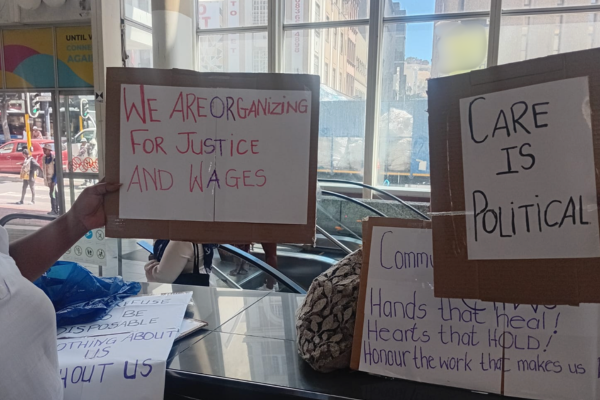
Community Health Workers joined civil society protests in Cape Town ahead of the national budget speech on 25 February 2026.
LRS is examining the gendered nature of care work in the Extended Public Works Programme, focusing on Volunteer Food Handlers, Community Health Workers, and Early Childhood Development Practitioners. These workers operate at the frontlines of care: cooking and cleaning in school kitchens, supporting health of the most vulnerable in some of the most indigent communities, and serving as the first agents and conduits of socialisation in early learning environments. Their roles are foundational to both social welfare and developmental outcomes. Yet, despite the depth of skill, emotional labour, and responsibility embedded in their work, care labour continues to be framed through a largely gendered lens that renders it invisible, naturalised, and therefore undeserving of adequate compensation and structural recognition.
This invisibility is historically produced and institutionally sustained. Care work has long been associated with femininity, domesticity, and moral duty, rather than with professional expertise or economic contribution. As a result, labour that involves nurturing, feeding, cleaning, and supporting others is often seen as an extension of women’s “innate” roles rather than as skilled work that requires training, discipline, and sustained commitment. When work is constructed as natural, it is simultaneously constructed as undeserving of fair pay, legal protection, and professional development. In this way, the gendered assumptions that shape care work do not merely affect perception; they materially shape working conditions, remuneration structures, and policy priorities.
Importantly, the devaluation of care work cannot be separated from its racialised dimensions. In many contexts, including South Africa, care work is disproportionately performed by Black women and women from economically marginalised communities. This intersection of race, gender, and class situates care workers within a hierarchy of labour that privileges formal, male-dominated professions while rendering feminised and racialised labour peripheral. The public imagination often views care workers as helpers rather than professionals, as supplementary rather than essential, and as temporary rather than career-oriented. These perceptions are reinforced in subtle ways through language, policy categorisations, and funding priorities that continue to treat care work as informal or auxiliary labour rather than as a core component of social infrastructure.
Law and policy frameworks, while increasingly acknowledging the importance of social care, still reflect these embedded biases. Care roles that are community-based or volunteer-driven are frequently excluded from comprehensive labour protections, structured remuneration models, and sustained professional training pathways. Where recognition does exist, it is often symbolic rather than substantive. This creates a paradox in which care workers are publicly praised for their dedication while remaining structurally underpaid, under-resourced, and under-protected. The gap between appreciation and material recognition reveals how deeply gendered and racialised assumptions continue to shape whose labour is formalised and whose remains precarious.
The characterisation of care work as “voluntary” or “natural” further entrenches this inequity. Volunteer Food handlers who ensure that children and vulnerable populations are fed, community health workers who provide essential frontline support, and early childhood development practitioners who shape foundational learning experiences are all engaged in labour that is both socially necessary and economically valuable. Yet the voluntary framing of such roles often obscures the intensity and indispensability of the work performed. It creates the impression that care is a moral contribution rather than a labour function, thereby justifying limited compensation and insufficient institutional investment.
There is, however, nothing natural about unpaid labour. Nor is there anything inevitable about the persistence of harmful norms and standards that influence how women are seen and valued in the workplace. These norms are socially constructed and continuously reproduced through institutional practices, policy omissions, and cultural narratives. When care work is undervalued in professional settings, this devaluation extends beyond the workplace, shaping broader societal attitudes about women’s labour, dignity, and worth. It trickles into the home, the community, and the economy, reinforcing the expectation that women’s labour should be given freely, quietly, and without sustained recognition.
A reflective engagement with care work therefore requires more than appreciation; it requires a critical interrogation of the systems that sustain its marginalisation. To recognise care workers meaningfully is to challenge the gendered and racialised assumptions embedded in law, policy, and public discourse. It is to affirm that cooking, cleaning, caregiving, and early childhood support are not informal extensions of domestic roles, but skilled and essential forms of labour that sustain social wellbeing and development.
As we continue to centre the experiences of care workers in our work, it becomes increasingly clear that visibility alone is insufficient. Structural recognition must follow. This includes fair remuneration, access to training and professional development, formal inclusion in labour frameworks, and policy approaches that acknowledge care work as integral to social and economic systems. Only then can we begin to dismantle the longstanding perception that care is a natural duty rather than a form of labour deserving of dignity, protection, and value.
Ultimately, confronting the gendered and racialised devaluation of care work is not only a labour issue; it is a question of justice. It calls for a shift in how we conceptualise essential work, whose labour we formalise, and whose contributions we render invisible. In recognising care work as skilled, essential, and deserving of structural support, we move closer to building a more equitable and dignified framework of work, one that acknowledges care not as silent obligation, but as foundational labour that sustains society itself.
RELATED ARTICLES
Care workers’ convergence: A festival of stories
Unlocking the true value of women’s work in school nutrition
7 February is the inaugural Care Workers’ Day
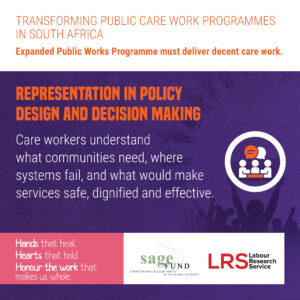
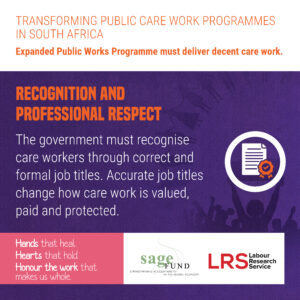
Care workers demand recognition and respect, and representation in policy design and decision making.