

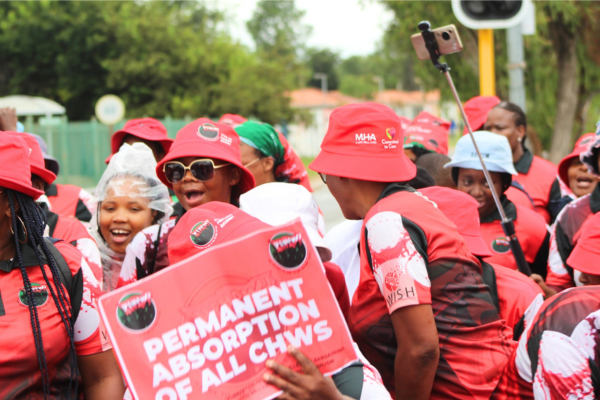
Community Health Workers won permanent employment in court – then the state rewrote the rules. This analysis tracks how a landmark victory became a new form of exclusion.
In January 2025, the labour court ruled that Community Health Workers must be deemed permanent employees of the state. This is a major victory after years of struggle. For decades, Community Health Workers have worked under precarious conditions – rolling contracts, stipends instead of salaries, and no pension. The court affirmed what Community Health Workers have always known: their work is permanent because the need for care is permanent.
The labour court found that Community Health Workers do permanent, essential work and that, under section 198B of the Labour Relations Act, they must therefore be treated as permanent employees. The law was introduced to prevent employers from keeping workers on rolling temporary contracts for ongoing work. In other words, permanent work cannot be labelled as temporary work, and funding arrangements do not alter this fact.
Community Health Workers are not temporary add-ons to the health system, they are its backbone. They detect TB and HIV, support pregnant women, monitor chronic illness, make referrals, and reach communities long before health problems become crises. Without them, an already overburdened public health system would face even greater strain.
The January 2025 ruling did not emerge in a vacuum. In 2018, the state had already acknowledged the essential and ongoing nature of Community Health Workers’ work through a Public Health and Social Development Sectoral Bargaining Council resolution signed by the Department of Health and the unions NEHAWU, DENOSA, PSA, HOSPERSA and NUPSAW.
The 2018 agreement recognised Community Health Workers as part of the primary healthcare system through the Ward-Based Primary Healthcare Outreach Team framework. It committed the Department of Health to develop standard procedures for recruitment, appointment, placement, skills development and absorption into the health system. Crucially, it applied to Community Health Workers with matric, those with experience, and those who could benefit from Recognition of Prior Learning – acknowledging that many had built substantial healthcare knowledge and skills outside formal qualifications. Although framed as a 12-month interim measure, it pointed towards a longer-term goal of integrating Community Health Workers into the formal public service.
A further resolution in 2022 extended the arrangement for another three years while acknowledging that the pathways to permanent absorption had still not been finalised. Community Health Workers remained on stipends, with annual increases tied to ministerial determinations rather than salaried posts. The question of permanent employment was deferred again, with parties required to finalise negotiations by March 2025. Instead of completing the transition, the 2022 agreement prolonged the interim arrangement and kept Community Health Workers in precarious work. The state recognised care as permanent, but not the carers doing the work.
A partial victory dressed up as a full one
In November 2025, the Department of Health and NEHAWU signed an implementation agreement to give effect to the labour court ruling. On paper, this appeared transformative. The agreement confirmed permanent appointments for eligible Community Health Workers at Public Service Salary Level 2, with back pay from 1 September 2025 and pensionable salaries from December 2025. It also affirmed the importance of Community Health Workers to primary healthcare and National Health Insurance.
However, the implementation agreement introduced eligibility conditions that were never set by the court, allowing the Department to apply criteria on who could be absorbed. The absorption process was staggered, leaving thousands of Community Health Workers in prolonged uncertainty and creating divisions between those being absorbed into permanent posts and those left behind on another one-year contract, with no guarantee of renewal in 2027. Those not being absorbed are now earning less than half of what a permanently employed Community Health Worker earns, and without any of the benefits of permanent employment.
The state’s refusal to end the precarious nature of this work follows a familiar pattern: care work is exploited and devalued on the assumption that women will continue to care regardless of formal recognition or decent conditions. The resolution reproduces the idea that essential care work can remain indefinitely on the margins of formal employment – the state keeping its options open while the workers, the majority of whom are women, absorb all the insecurity and stress.
The state framed absorption into permanent jobs as a privilege to be earned rather than an established right.
Each extension without absorption narrowed the window of justice, ageing the workforce and giving the State the ammunition to make educational exclusion easier to rationalise. The exclusion of experienced Community Health Workers without matric is not a sudden betrayal – it is the culmination of years in which permanence was acknowledged in theory but denied in practice. It was only when Community Health Workers went to court that the stalemate broke.
The ruling reproduced exclusion not because the court required it, but because the state chose to implement it in a way that protects its fiscal and managerial interests rather than the rights of Community Health Workers. The Labour Court’s judgment was straightforward: Community Health Workers must be deemed permanent employees because the work they do is permanent. It focused on the nature of the work, not age or educational history. The exclusion came during implementation, when the State introduced the matric criterion, which had never been a condition of the work itself. The effect was to give the illusion of compliance while narrowing who would benefit.
The state framed absorption as a privilege to be earned rather than an already established right. The collective victory is now partial: some Community Health Workers are being absorbed while others – those without matric, mostly older women – are being pushed out of the very jobs they built.
Recognition of Prior Learning as a remedy that is no remedy
Community Health Workers are being forced to prove their qualifications for work they have been doing for years.
For Community Health Workers excluded by the matric criterion, Recognition of Prior Learning was presented as the solution, despite the absence of clear timelines, guaranteed funding, identified institutions or assured outcomes.
Recognition of Prior Learning, when properly resourced and collectively supported, can be a powerful corrective to educational injustice. But in practice it is notoriously slow, individualised, costly and inaccessible. It requires assessors, portfolios of evidence, institutional support and funding, none of which were guaranteed in the implementation agreement. The state knows this. Unions have warned against this. Yet Recognition of Prior Learning is presented as a neutral option to fix a structural injustice created by the state itself – shifting responsibility from the institution onto individual workers, forcing them to prove their qualifications for work they have been doing for years.
Questions to NEHAWU as signatory of the implementation agreement
This moment also raises important questions for NEHAWU as signatory to the implementation agreement.
How did the union assess the risk that the agreement might exclude long-serving Community Health Workers without a matric qualification, particularly older women whose skills were built through years of frontline care work rather than formal education? What confidence was there that Recognition of Prior Learning would be implemented in a funded, collective and enabling way, rather than becoming another administrative barrier? How were the voices and experiences of Community Health Workers without matric incorporated in shaping the agreement, and what mechanisms exist for those workers to influence how unresolved issues are now being addressed? And given that the Labour Court ruling established permanent status based on the nature of the work and not educational credentials, how does NEHAWU understand its role in challenging interpretations of the agreement that downgrade experienced Community Health Workers into cleaning or support roles, effectively erasing their professional identity?
For LRS, the broader question is: what lessons can we draw from this process about how implementation agreements can protect, rather than fragment, feminised workforces so that hard-won victories do not leave the most marginalised women bearing the cost of compromise?
From delay to outright exclusion
In March 2026, the consequences became explicit. The Department of Health informed NEHAWU that Community Health Workers without matric would not be considered for permanent appointment as Community Health Workers at all. Provinces were instead authorised to offer them alternative roles of cleaners, porters, messengers or other support positions. This is not redeployment. It is occupational demotion.
Women who have spent 10, 15, even 20 years doing critical care work are now being told their skills no longer count. The state is effectively saying: your knowledge was good enough when we needed you in the field, but not good enough to make you a permanent employee of the Department of Health.
Your knowledge was good enough when we needed you in the field, but not good enough to make you a permanent employee of the Department of Health.
For the women affected, the consequences are devastating. Community Health Workers speak of fear and silence, of divisions between those absorbed and those left behind, of workloads increasing while recognition shrinks. Some avoid protests because visibility could cost them what little security they still have.
After all these years, Community Health Workers who are not being absorbed are being told to be patient.
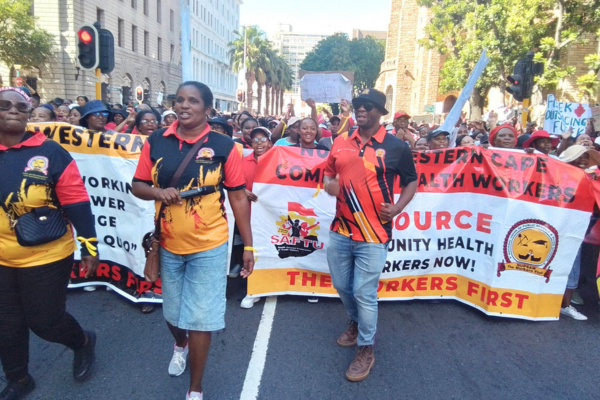
The National Union of Public Service and Allied Workers (NUPSAW) and Community Health Workers marched to the provincial legislature on 16 April to demand insourcing and absorption. The Western Cape Department of Health and Wellness has refused to comply with the Labour Court ruling that Community Health Workers are permanent employees. Photo: NUPSAW
Why is this happening?
This situation exists because care work done mostly by women is devalued and treated as a natural extension of women’s roles in the home. The health system depends on Community Health Workers to keep communities healthy, yet the state has worked to keep this workforce cheap, flexible and under control. By first delaying permanent employment, then adding new requirements, and now excluding women with years of experience, the state is avoiding the full cost of secure jobs, salaries and benefits.
What looks like technical decision-making is, in fact, about power.
The state protecting its budget and control while working-class women carry the stress, insecurity and risk.
The irony is cruel. The health system cannot function without Community Health Workers. Clinics and hospitals rely on them to go where the system cannot. Yet at the moment of formal recognition, the state redraws the boundaries of belonging to exclude the very women who carried the system through its most under-resourced years.
Where to from here?
We need to begin with a truth: you cannot build a caring state while discarding, at your convenience, those who do the care work. After years of struggle, the court ruling opened a door. But for many Community Health Workers, the door led not to security, but to new forms of exclusion.
The struggle for absorption must be framed by the broader struggle for the recognition and valuing of care work. This means rejecting every narrative that reduces Community Health Workers to low-skilled or auxiliary roles, and insisting on the essential nature of the skills and knowledge Community Health Workers have built through years of frontline work – the very work that created the primary healthcare system we have today.
Those who bore the cost of compromise at the negotiating table, that is, the women excluded because of matric, must shape the next phase of the struggle. They must be supported to tell their stories, to speak publicly, collectively and safely. We must treat experience and longevity as leadership assets.
We must resist division and fragmentation, and organise around demands that apply to all Community Health Workers. A Recognition of Prior Learning process, for example, can benefit all Community Health Workers by formally acknowledging the knowledge and skills developed over years of service.
We must challenge the stripping of the professional identity of Community Health Workers and push back against any policy or practice that reclassifies experienced Community Health Workers as unskilled labour.
Community Health Workers are not alone. Their conditions echo those of Volunteer Food Handlers, Early Childhood Development practitioners and many other care workers. We must strengthen the Care Worker Platform and its call for care to be recognised as a public good requiring public investment.
The task ahead is to build power with those most marginalised, challenge the fragmentation produced by partial victories, and deepen the struggle for a public health system that recognises care work as skilled, dignified labour.
RELATED ARTICLES
Absorbed on paper, invisible in practice
Community Health Workers still outsourced despite court ruling
Recognition of Prior Learning as a collective journey
The everyday violence against Community Health Workers
Decent work goals for care workers