
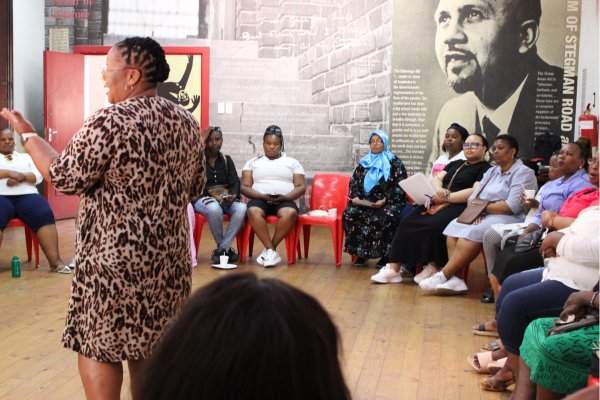
Photo: Community Health Workers at the launch of the Care Workers Day campaign poster in December | Community House, Cape Town
The very foundations of South African national pride are built on freedom, dignity and equality. Dignity here is emphasised because it speaks to ensuring that past inequities do not repeat themselves, grounded in the understanding that a deliberate effort must be made to repair decades of systemic dehumanisation, humiliation and inequality. With this context in mind, it is particularly disheartening to see the treatment of Community Health Workers and the hurdles they have to pass through in order to be afforded this very dignity we so often invoke.
There is something deeply unsettling about a democracy that speaks the language of dignity while outsourcing care to those it refuses to dignify. Community Health Workers sit at the fragile intersection between the state and the most vulnerable. They carry medicine, information, emotional labour, and often the burden of navigating broken systems. Yet, despite being essential to the functioning of public health, they remain structurally peripheral, underpaid, precariously employed, and persistently unseen.
Recent legal challenges brought on behalf of Community Health Workers have laid bare what many have long known, that the state’s reliance on their labour is not matched by a recognition of their rights. In this case, the court was asked to confront a fiction, that Community Health Workers are merely “volunteers” or “stipend earners,” rather than workers deserving of the full protection of labour law. This fiction is not benign. It is a legal and political mechanism that allows the Department of Health and its intermediaries to benefit from labour without assuming responsibility for it.
What emerges from these judgments is not only a technical clarification of employment status, but a moral indictment. The courts have increasingly recognised that where there is control, supervision, and integration into the core functions of the health system, there exists an employment relationship, regardless of how it is labelled. In doing so, they expose the dissonance between the constitutional promise of dignity and the lived reality of care workers.
But beyond the legal reasoning lies something more troubling: the normalisation of indignity. Community Health Workers are required to show up daily to walk long distances, to enter homes marked by poverty and illness, to provide care in contexts where the state itself is often absent. Yet they must also fight, repeatedly, to be recognised as workers, to be paid consistently, to be treated as more than an expendable extension of a strained system. This is not simply an administrative failure. It is a form of structural violence.
The care economy in South Africa is built on a contradiction. On the one hand, care is essential, it sustains life, reproduces labour, and holds communities together. On the other, it is systematically undervalued, particularly when performed by Black women. Community Health Workers embody this contradiction. Their labour is indispensable, yet treated as if it is optional, informal, or supplementary.
The Department of Health’s approach to Community Health Workers reflects a broader political economy of care, one that externalises costs onto those least able to bear them. By maintaining precarious employment arrangements, the state effectively shifts the burden of healthcare delivery onto workers who themselves remain economically insecure. The result is a system that depends on care while refusing to care for its caregivers.
The recent wave of litigation disrupts this arrangement. It forces the state to account for its practices, to justify the gap between its constitutional obligations and its operational realities. And in many instances, it reveals that this gap is not accidental but deliberate, a product of policy choices that prioritise flexibility and cost-saving over fairness and dignity.
Yet, even as courts affirm the rights of Community Health Workers, implementation remains uneven. Legal victories do not automatically translate into material change. Workers continue to face delayed payments, unclear contracts, and a lack of benefits. The law, it seems, can recognise dignity without guaranteeing it.
This is where the Care Workers Day series becomes crucial. It is not merely a commemorative exercise, but a political intervention. It insists that care workers are not peripheral to our democracy, they are central to it. It creates a space to name the contradictions, to document the injustices, and to refuse the quiet erasure of those who sustain life under impossible conditions.
To speak of dignity in this context is to do more than invoke a constitutional value. It is to ask what dignity looks like in practice. Is it dignity to work without job security? Is it dignity to provide care while living in precarity? Is it dignity to be celebrated rhetorically but neglected materially?
The treatment of community health workers suggests that dignity, in South Africa, is still unevenly distributed. It is something that must be claimed, fought for, and, in many cases, litigated into existence. This reality sits uneasily with the image of a nation committed to equality and justice.
There is a tendency to view care work as inherently noble, as something that transcends material concerns. But this framing is dangerous. It obscures the conditions under which care is provided and allows exploitation to be recast as sacrifice. Community Health Workers are not asking for recognition because their work is noble. They are demanding it because their work is labour, and labour, in a constitutional democracy, must be protected.
The question, then, is not whether we value care. The question is how that value is expressed, and who bears the cost when it is not.
As we reflect on the stories emerging from the courts and from the lives of Community Health Workers themselves, we are confronted with an uncomfortable truth: the dignity we claim as a nation is, in many ways, aspirational. It exists in law, in rhetoric, and in national identity, but not always in practice.
And so we are left with a question that lingers beyond any single judgment or policy reform: What does it mean to build a society on dignity, if those who sustain its very capacity to care are the ones most consistently denied it?
RELATED ARTICLES
How the state undermined the rights of Community Health Workers
Recognition of Prior Learning as a collective journey
The politics of care