
The life of a child is precious. It is innocent, fragile, and foundational to the health of any nation. Every society is measured by how it cares for the development of its children, and whether the respective country’s development policy and implementation truly prioritise their survival, safety, and development. In South Africa, over 3 000 children are born every day, many of whom are born into families living below the poverty line where income is insufficient to meet even basic food, health, and shelter needs, and where malnutrition, illness, and social vulnerability are daily realities. The South African government provides coordinated support through its public service delivery systems which are responsible for implementing early childhood development, learning, health, and social protection. However, these systems are strained, under-resourced, and lean heavily on the invisible backbone of South Africa’s care economy, namely the Community Health Workers (CHWs), Early Childhood Development (ECD) practitioners, and Food Handlers working within the Expanded Public Works Programme (EPWP).
Together, these women, mostly employed in precarious contexts, carry the nation’s children from before birth to school-leaving age or adulthood. CHWs care for communities (including children)’s physical and mental wellbeing, ECD practitioners nurture early learning, Food Handlers ensure that school children are fed nutritious meals daily. Yet their work, rooted in love and service, is systematically undervalued and under-remunerated because it mirrors the unpaid reproductive labour expected of women at home.
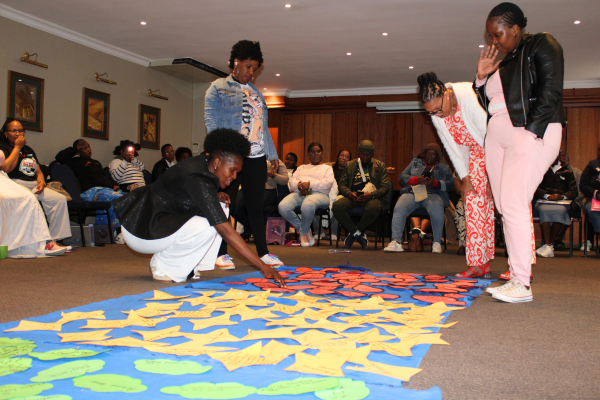
In October 2025, the LRS convened a Care Worker’s Convergence which brought together these three layers of care workers. The gathering created a powerful space for care workers in the EPWP to speak, reflect, and recognise the collective value of their work as holding the nation together from birth to adulthood. For three days, the care workers shared stories, reflected on their respective struggles, connected with one another, and began to shape a shared vision for justice and Decent Work in the care economy.
When the LRS started working with the three groups, many of the care workers struggled to see how their worlds of work connected. Each group operates within a different institutional framework, with distinct mandates and daily routines. For example, an ECD practitioner’s day revolves around early learning and stimulation, while a Food Handler focuses on nutrition and feeding, and a Community Health Worker walks door-to-door tending to families’ health needs. Their work takes place in separate spaces, namely classrooms, kitchens, clinics, and is shaped by separate policies and reporting lines.
Yet, through dialogue at the Convergence, they began to see that they are part of one ecosystem of care, bound by the same purpose around ensuring that every child is nourished, healthy, and able to thrive. What had once seemed like separate silos of service began to reveal themselves as interconnected works of care, forming a continuous chain that supports a child from birth to adulthood. The three care worker groups began their time together by symbolically welcoming one another with gifts, each gesture expressing the essence of their work. The Food Handlers presented each participant with a wooden spoon, a powerful emblem of nourishment and the daily labour of feeding. Their gift also reflected their shared commitment to decolonising the idea of nutrition and challenging the narrative that the NSNP exists only for “poorer” children. The ECD practitioners gifted each participant a learning pack, a small exercise book and pencil representing the centrality of learning, imagination, and play, and their role as educators in the pre-foundation phase. Finally, the Community Health Workers offered care packs filled with health-preserving and disease-preventative items as tangible reminder of their critical work in keeping families, children and communities well.
Working with the metaphor of the sky, they mapped their realities in a language that held both struggle and possibility. They spoke of dark clouds representing exhaustion, low pay and the emotional toll of caring under impossible constraints. They pointed to breaks of sunlight as symbols of hope, community strength, and the moments when their work changes a child’s life. They envisioned open skies as the future they are fighting for, a future where care work is recognised, protected, and fairly remunerated. Through this shared metaphor, they found a common language that allowed them to articulate what they carry, what they endure, and what they dream of transforming.
“This is a career. Having a child is not a qualification. Being a mother doesn’t make me a woman; I am a woman first. Also, being a woman doesn’t make me a carer. Care work is work.” – Phumlile, convergence participant.
The convergence addressed even further the divisions between sectors. For CHWs learned of the daily struggles of Food Handlers, who feed nearly 9 million learners every day while only earning a stipend of R 2 100 a month. ECD practitioners, collectively responsible for the early development and learning of approximately 2.5 million children, identified many commonalities with CHWs who support over 36.1 million people including families and children’s daily health needs.
The convergence revealed not only the pain of invisibility and undervaluing of care work, but also its power as a political and social identity. Care workers reclaimed and rewrote the narrative about them and came to the understanding that care is not just reproductive but it is work that is foundational to South Africa’s development.
At the end of the convergence, their vision was clear. Care workers demand a dismantling of the systematic injustices that make care invisible. They call for the restoration of the dignity to those who nurture our nation’s children and vulnerable members, and dream of a society that assigns care work the same economic and social value as any other form of labour.
As one participant concluded:
“We realised that we are the legs of one pot. When one breaks, the whole pot falls. The nation cannot stand without us.”
From these dialogues emerged the Care Platform for Decent Work, a collective vehicle to advocate for recognition, protection, and fair remuneration. Participants agreed that the struggle for decent work must be rooted in shared dignity and solidarity across care sectors. “three legs of the same pot,” as one participant described.
Post the convergence, across provinces, groups began organising local meetings, mobilising Food Handlers, CHWs, and ECD practitioners into a single movement of care. They renamed themselves not by job titles, but as care workers. This shared identity marked a turning point: from isolation to organisation, from invisibility to voice.
One CHW from Gqeberha reflected on how she had shared the outcomes of the convergence with other CHWs in their network saying,
“I told them there is no difference between them and us because we are all in the same struggle. When I gave them the report, it was a revival. I said: begin to love yourself first, not for money but for souls. Represent yourself as a professional person so that whoever doubted who you are, will see your dignity.”
From this convergence, one clear resolution emerged: to launch the first-ever Care Workers’ Day on 7 February 2026.
This day will celebrate the unseen labour of care workers and call for policy change to ensure that care work is recognised as essential, fairly remunerated, and protected by law.
Care workers envision a day of local gatherings, storytelling circles, community parades, and public exhibitions across provinces, supported by digital storytelling and livestreams. Provincial groups are already mobilising under the shared colours of the movement, symbolising unity and care.
“Care Workers’ Day is our chance to be seen. It’s a day to say we are the hands that hold the nation together.”
Care worker participant.
The South African Care Workers Forum (SACWF) has also resolved to write to the Minister of Social Development and the Parliamentary Committee on Social Development, demanding a clear position on the permanent employment and fair pay of care workers within all social sectors
The convergence revealed not only the pain of invisibility but also the profound power of care as a political and social force.
In uniting across sectors, care workers are rewriting the narrative: care is not charity, it is infrastructure; not a favour, but labour; not secondary, but foundational to South Africa’s development.
Their vision is clear: Care is labour, care is political, and, and care workers demand the dismantling of the injustices that make care invisible, that restores dignity to those who nurture others, and that assigns care work the same economic and social value as any other form of labour.
As one participant concluded:
“We realised that we are the legs of one pot. When one breaks, the whole pot falls. The nation cannot stand without us.”
RELATED ARTICLES
Care workers’ convergence: A festival of stories
Community Health Workers: “Nothing about us without us”
The crisis facing Early Childhood Development Practitioners
I am a Food Handler, and I deserve dignity and rights