

The apartheid-era passbook carried a photograph, an employer’s signature, a stamp authorising its holder to be in a particular place and a record of the work she was allowed to do. Without it, she could be arrested.
On 9 August 1956, more than 20 000 women marched on the Union Buildings to reject the state’s plan to extend the pass to African women. Lilian Ngoyi, Helen Joseph, Rahima Moosa and Sophia Williams-De Bruyn led the march. The organisers chose a Thursday, traditionally a day off for Black domestic workers, so that more working women could attend.
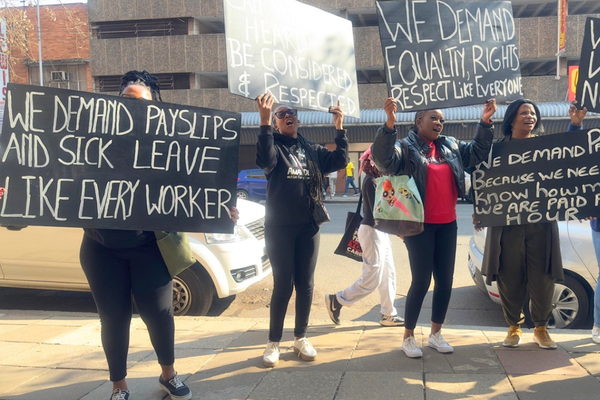
Seventy years later, the pass is gone. The question of records of women’s working life is not. The pass tied a Black woman’s movement, residence and employment to a document controlled by the state. For many women workers today, it is the other way round. There is no written contract and no payslip, and often no clear record of who employs her, what she is paid or how long she has worked. These are different systems with different purposes. Both leave women with little control over the record of their working lives.
A document is not an administrative nicety. It can decide whether a worker has a claim she is able to prove. Without a contract or a payslip, it is harder to show income to a landlord or a lender, to establish what was owed in a dispute, to claim compensation for a workplace injury, or to demonstrate length of service when a job ends. If she is dismissed after 11 years, those 11 years should be more than a story she has to tell.
Section 29 of the Basic Conditions of Employment Act requires an employer to give an employee written particulars of employment when they start work. These include the employer’s details, the worker’s job, place of work, hours, pay, deductions, leave, and notice or contract period. The provision applies to employees who work more than 24 hours a month for an employer. So in many cases the missing contract is not a gap in the law. It is a failure to give workers the record the law already requires. Enforcement is genuinely difficult. A private household is not a factory or office. The practical result is still the same. The worker is left to prove her own employment at the moment she needs to claim a right.
Nobody is arrested today for failing to carry an employment contract. What workers face now is produced through weak enforcement, insecure employment, administrative decisions and the distance between policy and practice. The two systems are not equivalent, and saying so is not a concession. It is the reason the comparison is worth making at all.
Under apartheid, the state recorded Black women’s movement and employment in order to control them. Today, the absence of a reliable employment record leaves women struggling to establish rights they already hold. The form of power is different. The question of who gets to define a woman’s work is the same. The women of 1956 argued that the pass would restrict their movement, break up families and subject them to daily humiliation. Women organising today are demanding recognition, fair pay and decent work.
This Women’s Day marks 70 years since the 1956 march. The National Women’s Parliament meets in Kimberley on 13 and 14 August to reflect on 70 years of women’s resistance and progress towards gender justice and equality. Parliament says the programme will also examine the gap between rights promised in law and their implementation.
Here is an exercise: Find a working woman. Ask her what she earns and her conditions at work. Then ask whether she has a document that says so.
Women’s Day should ask a basic labour question. Whose work is recognised, whose work is recorded, and whose rights follow from that recognition?
Much of that struggle is fought at the bargaining table. Here are some resources to help unions put gender equality into collective bargaining and workplace demands.