
Trade policy and practice is shaped far from workers and yet these dynamics shape our African economies, they shape what we produce, what we consume, what price we pay, what jobs are available to us and what is the quality of those jobs. We tell the story of our efforts to support the trade union movement in Africa to project the voice of the working class into seemingly distant policy spaces.
Voice is the ability of workers to shape decisions affecting their work and livelihoods. Too often workers’ voices are excluded from policy and decision-making. This exclusion is particularly visible in trade policy, where deals are negotiated through executive processes. The African Continental Free Trade Area (AfCFTA) is one such example. AfCFTA seeks to expand intra-African trade and regional value chains to drive industrialisation and job creation. But its framework lacks labour provisions, leaving workers’ voices and rights outside the agreement.
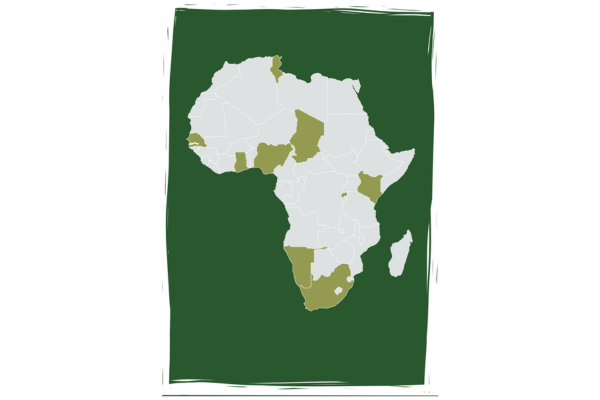
The LRS is working with ITUC-Africa and affiliates in nine countries to build the competencies required to bring workers’ voices into the implementation of the AfCFTA. We are contributing to reversing the marginalisation of labour in trade policy by strengthening unions’ advocacy, capabilities, research and solidarity networks.
This is the story of our work in supporting ITUC-Africa national centres in South Africa, Namibia, Ghana, Nigeria, Chad, Senegal, Tunisia, Rwanda and Kenya to advance a decent work agenda in the AfCFTA.
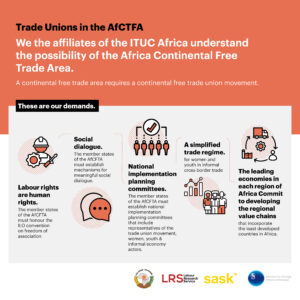
Trade is a trade union issue
Trade and the AfCFTA are now part of mainstream union agendas, a significant shift from the limited attention previously given to the topic. Union leaders debate AfCFTA; union processes reference it; and campaigns link trade directly to employment, industrial development and workers’ rights. New structures, research priorities, collaborations and tailored training programmes have emerged.
“Voices of workers in trade agreements cannot be ignored. It is in our factories, fields, offices and streets that wealth is created. The AfCFTA can be a lever for meaningful employment, but only if it is grounded in solidarity, equality and sustainability, and meaningful social dialogue.”
– Mohammed Faical KadhKadhi, Coordinator, Department of Studies and Documentation, Tunisian General Labour Union.
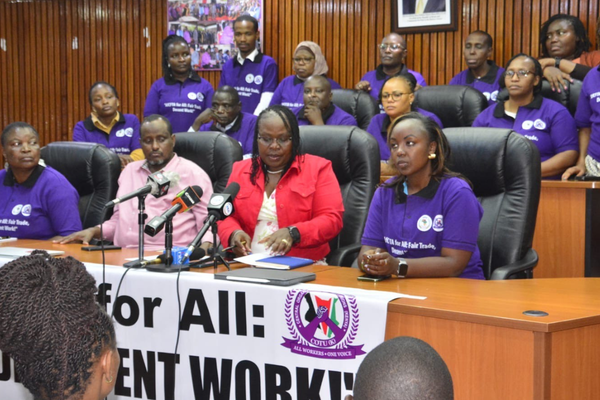
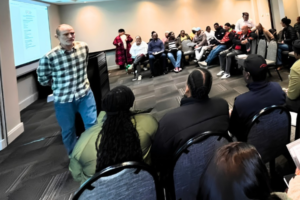
The Central Organisation of Trade Unions of Kenya demand workers voice in AfCFTA's implementation, amid growing protectionist policies and shifting global trade dynamics | February 2025, Nairobi
Unions strengthened capacity to understand and act on AfCFTA and wider trade issues. Across participating countries, union leaders and coordinators now demonstrate greater confidence in analysing trade, articulating labour positions and engaging policy debates. There is growing use of research, policy, and media tools. Capacity gains were uneven, reflecting different starting points.
Organising women in informal cross-border trade
The Union of Trade Unions of Chad (UST) used competency building support by LRS to renew its organising strategy for women in informal cross-border trade.
UST organised women traders into a cooperative, and trains them on customs procedures and rights. Women informal cross border traders contribute about 41 per cent of Chad’s GDP. UST advocates for a simplified trade regime for women and youth to bridge the gap between informal trading practices and formal customs systems.
UST is also educating affiliates, particularly in agriculture and manufacturing sectors.
“I expanded my business and reached new markets through the UST cooperative. Before the training, I traded in small quantities and faced many barriers at the border. The union connected us to the women entrepreneurs network in Chad.”
– Kadji Bio, informal cross-border trader and UST activist
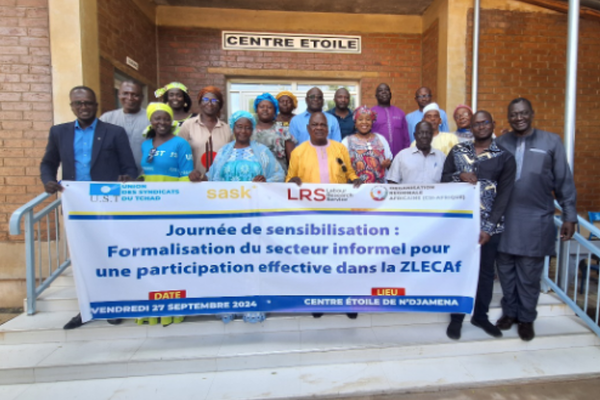
The Union of Trade Unions of Chad campaigns on formalising the informal sector to ensure effective participation in the AfCFTA | September 2024, N'Djamena.
Entering trade governance spaces
Unions are increasingly recognised as stakeholders, and governments are more willing to collaborate with labour in trade facilitation. This shift led to the inclusion of trade unions in AfCFTA National Implementation Committees in Rwanda (Trade Union Centre of Workers of Rwanda) and Namibia (Trade Union Congress of Namibia). Other ITUC-Africa national centres participate in national social dialogue platforms and continue to demand representation in AfCFTA National Implementation Committees.
This change is significant. Before ITUC-Africa and LRS support, trade unions were largely disengaged from trade policy and governments did not consider trade a union mandate.
“CESTRAR has two seats on the AfCFTA National Implementation Committee, effective September 2025. Our road to inclusion in the committee was not easy, and we must not squander the opportunity to advocate for workers and to monitor AfCFTA’s implementation.”
– Africaine Biraboneye, General Secretary, Trade Union Centre of Workers of Rwanda (CESTRAR)
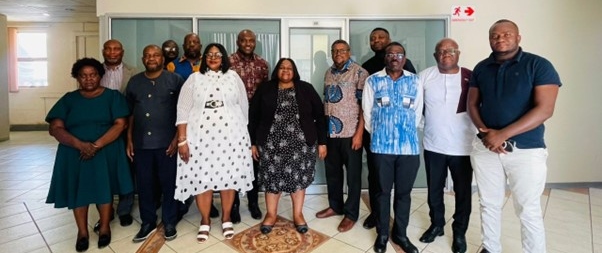
ITUC-Africa and Trade Union Congress of Namibia (TUCNA) delegation with the minister of Industrialisation and Trade in 2024 in Windhoek. TUCNA has two representatives at the AfCFTA National Implementation Committee.
A continental free trade area requires a continental free trade union movement
Trade unions have strengthened their online presence, influence and participation in trade discourse. They now articulate clearer positions and demands on the AfCFTA and speak with greater confidence on trade issues.
Campaigns are more structured. Advocacy tools support national and continental engagement. LRS produced videos featuring trade union leaders, youth and women calling for an AfCFTA that works for workers. Unions also practised rapid-response advocacy on trade and debt. Messaging and documenting change stories have become strategic union capabilities.
“One of the most useful and innovative elements of the LRS workshops was the focus on messaging. We often concentrate on political analysis but don’t spend enough time on how we communicate our message, whether to our members, bosses or government. LRS helped us clarify what matters most to workers regarding the AfCFTA and how to present it. COSATU was aligned and on point when we took our message to the global stage at Labour 20."
– Tanya van Meelis, Head of COSATU Policy Unit.

Trade unions seek inclusive and equitable implementation of the AfCFTA | Regional Capacity Development and Political Engagement Forum | June 2025, Nairobi
South Africa: Social dialogue in practice
Social dialogue across Africa is uneven. In many countries it is weak or absent. We are working to strengthen social dialogue as a pathway to a developmental and truly Pan-African free trade agreement.
South Africa has the most established formal social dialogue structure in Africa. We collaborated with NEDLAC, the country’s formal social dialogue body, to model constructive social dialogue in trade policy formation to unions from other African countries.
“Labour has various wins at NEDLAC, for example, preferential procurement, which we want to see under the AfCFTA… We must encourage information sharing on social dialogue and how to engage meaningfully. Where there is productivity, fair trade, and profits, we want to see the shared proceeds of that productivity.”
– Riefdah Ajam, General Secretary of the Federation of Unions of South Africa.
A media statement by ITUC-Africa, Labour Research Service, and NEDLAC called for a developmental regionalism approach to AfCFTA’s implementation. Symposium participants are optimistic about AfCFTA’s potential to unify African markets and advance social justice, recognising that sustained and inclusive social dialogue is crucial.
"Government alone might not be able to diagnose the impacts of the AfCFTA well. But through social dialogue where you have unions as one of the actors, one of the voices, a set of eyes - you get a much better reading of the national economy. It’s through social dialogue that we can do these fundamental things. Despite the fact that the trade union movement was left out of the negotiation phase, they should be participating in the implementation and monitoring phase to balance the outcomes of trade.”
– Trenton Elsely, Executive Director of Labour Research Service
"Social dialogue earns legitimacy when it delivers: a wage floor that tracks living costs (Ghana), transparent and implementable public-sector settlements (South Africa), and multi-year reforms that reach households (Morocco). These are the problem-solving engines when designed well. NEDLAC’s COVID rapid response shows us when the house is on fire, trusted dialogue can produce quick and targeted policy that protects jobs and incomes. We should not wait for crises to build that trust."
Dr Hod Anyigba, Executive Director of ITUC-Africa's Africa Labour Research and Education Institute.
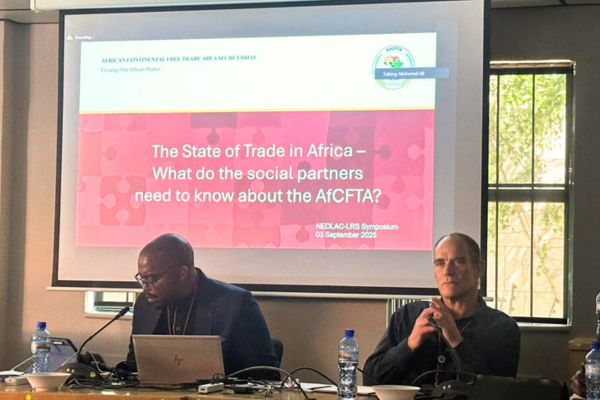
Mojalefa Radebe (L), Unit Manager at NEDLAC and Trenton Elsely (R), Executive Director of Labour Research Service

In this series:
Identity | The collective ‘coming out’ of care workers in the Expanded Public Works Programme
Capacity | for organising and representing worker interests
Belonging | in the trade union
Sustainability | through programme development