
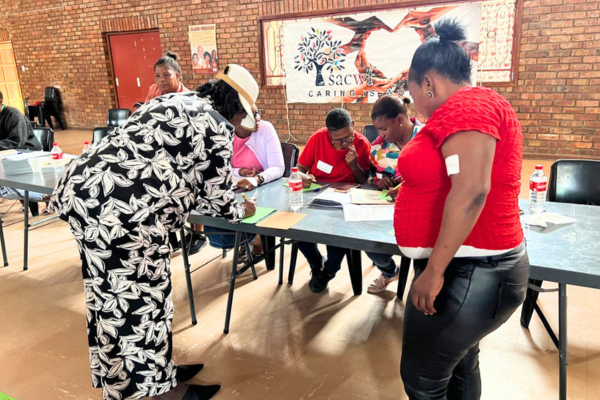
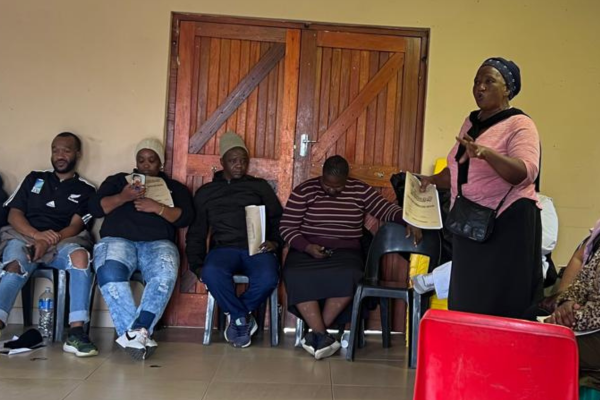
South African Care Workers Forum members at LRS Recognition of Prior Learning workshop in Northern Cape in April.
10 questions and answers for Community Health Workers advocating for absorption into permanent posts.
1. What is Recognition of Prior Learning, and why are we talking about it now?
Recognition of Prior Learning is a process that recognises the skills and knowledge you have gained through your work, not through school.
We are talking about it now because more than 16,687 Community Health Workers were left out of the absorption process that followed the January 2025 Labour Court ruling that Community Health Workers must be made permanent employees.
The Department of Health used administrative and educational requirements — including matric — to divide Community Health Workers. Many workers who have performed the same duties for years were left behind. The Department said those workers could pursue Recognition of Prior Learning as a pathway to absorption. It also raised fiscal constraints as a reason for the staggering absorption.
LRS and the South African Community Workers Forum (SACWF) argue that if Recognition of Prior Learning is being raised as a pathway, then it must work for Community Health Workers. We are holding the Department to that.
2. Does Recognition of Prior Learning mean I have to go back to school or write exams?
No. Recognition of Prior Learning is not a school process, and it does not test school knowledge. It recognises what you already know and already do as a Community Health Worker.
Assessment can include:
- oral interviews where you explain your work in your own words
- practical demonstrations of your skills
- workplace observation, where an assessor watches you doing your job
Recognition of Prior Learning should not create fear or shame. It should build confidence and support your progress. Recognition of Prior Learning should correct injustice, not reproduce it. It should recognise the years of household visits, health promotion, referrals, follow-ups and reporting, and support given through illness, poverty, disability and crisis. That includes the frontline care work Community Health Workers carried through HIV and Covid-19.
3. Will completing Recognition of Prior Learning mean I get absorbed — and does it give me something beyond that?
The Department has not yet provided a clear Recognition of Prior Learning process. We are demanding a concrete process that builds confidence, recognises women’s care work, and corrects past injustice.
Recognition of Prior Learning offers a fair chance to move into permanent posts without studying Grade 12. It also treats your experience and skills as real learning and can open access to qualifications such as NQF Level 3 Health Promotion and NQF Level 4 Community Health Worker qualification. These qualifications matter beyond absorption. They belong to you — not to the Department, not to the job — and they strengthen your position as a worker for the rest of your working life.
4. Can the Department legally use matric to exclude Community Health Workers who have been doing this job for years?
This is one of the key legal and fairness issues.
Employers generally cannot apply new qualification requirements retrospectively to workers who are already doing the job, especially where:
- the job description has not changed
- the duties remain the same
- the new requirement is used to exclude or disadvantage some workers
In the case of Community Health Workers, workers without matric have been performing the same duties as those with matric, often for many years. The job itself has not changed. The Labour Court ruled that Community Health Workers must be deemed permanent because the work represents a permanent need in the health system. Given this, adding matric after the fact as a requirement for absorption raises legal and fairness concerns. It conflicts with substantive fairness and equal treatment for work of equal value, and may amount to unfair labour practice or unfair discrimination.
Previous agreements, including PHSDSBC Resolution 1 of 2018, did not use matric in the same way. This requirement was brought in later through the implementation agreement. We are actively pursuing the legal argument.
5. We have heard of Recognition of Prior Learning before. Why should we trust it this time?
That scepticism is legitimate. What is different now is the pressure, the organisation, and the legal context. The Labour Court ruling exists. The demand for absorption is live. SACWF and LRS are already testing a collective Recognition of Prior Learning approach with Community Health Workers in East London and the Northern Cape. What the workshops have shown is that although Recognition of Prior Learning outcomes are recorded individually, the journey does not have to be isolating or intimidating. Many parts of the process can be done collectively, allowing Community Health Workers to support one another, build confidence and affirm the value of their work.
6. How does a collective Recognition of Prior Learning process work?
A collective Recognition of Prior Learning process means Community Health Workers move through the key stages together, with support from SACWF, unions and LRS.
A collective approach:
- recognises that Community Health Workers’ knowledge is community-based and shared
- counters the fear many workers feel about not having a Grade 12
- supports dignity, confidence and solidarity
- aligns with union support for Recognition of Prior Learning as a pathway to permanent jobs
- reinforces that Recognition of Prior Learning should open doors, not exclude workers who have already been doing the work for years.
7. What can a collective Recognition of Prior Learning journey look like in practice?
Many parts of the journey can be done in groups.
Information sessions
These sessions explain the process, what will be expected, and what evidence may be needed. They help Community Health Workers ask questions together and understand that they are not alone.
Shared self-assessment
Identifying your skills is more affirming when done in community. Workers help each other name competencies they may have undervalued for years.
Building portfolios of evidence together
The portfolio belongs to each individual, but the process of building it can be collective. Workers can support each other to gather letters, logs and records. Supervisors and NGOs can provide confirmation letters. Group sessions can help workers organise their evidence.
Collective preparation for assessment
The assessment may be individual, but readiness for it can be built together. Workers who prepare collectively — who understand what is being assessed and practise speaking about their work — approach the process with confidence rather than anxiety.
8. What have we learned about a collective recognition of prior learning journey?
In the LRS/SACWF workshop in East London, Community Health Workers took part in a hand-mapping exercise, tracing their hands on paper, with each finger representing a skill used in daily work. The exercise helped workers recognise the full value of their work and connect individual skills with the broader competencies required of a Community Health Worker:
Health promotion skills
- counselling
- identifying risks
- explaining health messages
- understanding TB, HIV, chronic conditions and maternal health
- knowing how to speak to different households
Clinical support and screening
- blood pressure and blood sugar checks
- TB and HIV screening
- maternal and child health assessments
- monitoring chronic patients
Community navigation and outreach
- mapping households
- identifying vulnerable families
- home visits
- referral networks
Administration and reporting
- completing forms
- capturing data
- following reporting timelines
- record keeping
Emotional, cultural and social competence
- cultural sensitivity
- supporting survivors of gender-based violence
- mediating family conflict
- providing psychosocial support
9. What are Community Health Workers saying about a collective RPL journey?
Workers are saying the process is helping them name their value and stand in it with more confidence.
SACWF members at LRS Recognition of Prior Learning workshop in East London in March.
“I learnt that even though I don’t have a Grade 12 certificate, there are skills that I have that I can be proud of. It was a good reminder for me because I am made to feel like these things don’t matter. I have some confidence.”
— Community Health Worker
“Before I would just watch things happening because to question anything means putting your job on the line. Now I feel empowered because I can hear things that concern me being explained to me clearly. I know my position and responsibilities better. The department still needs to provide a meaningful way forward.”
— Community Health Worker
“We need to support and motivate one another. We must be so united that no one feels they have to carry this struggle alone. Even those who have already been absorbed must remember where they come from and continue to support the struggle.”
— Community Health Worker
10. What must happen next?
The Department of Health must stop speaking about Recognition of Prior Learning in vague terms. The department must provide:
- a clear process
- named institutions
- proper support for workers
- clarity on evidence and assessment
- funded assessments
- a pathway that counts toward permanent posts and broader qualifications
Community Health Workers have already proven their value. Recognition of Prior Learning must not become another barrier. It must become a pathway that recognises women’s care work, affirms workers’ experience, and supports decent work, fair pay and permanent posts. And it must be a pathway Community Health Workers must walk together.
RELATED ARTICLES
Absorbed on paper, invisible in practice
Community Health Workers still outsourced despite court ruling
The everyday violence against Community Health Workers