
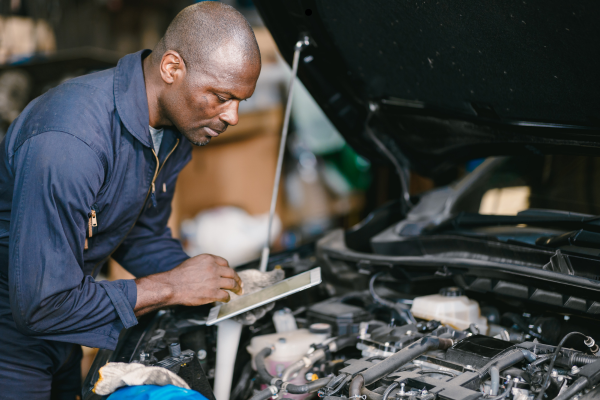
South Africa’s transition to electric cars is expected to reshape employment within the auto maintenance and repair industries. Although the transition is likely to be gradual, it will alter the nature of repair work, skills demand, and business viability for auto mechanics, particularly within the informal economy.
In the second quarter of 2025, 220 000 people were employed as auto mechanics, with employment evenly split between the formal and informal sectors. They accounted for around a fifth of employment across the value chain. Formal employment, however, declined from 132 000 workers in 2010 to 110 000 workers in the second quarter of 2025, while informal employment doubled over the same period. The COVID-19 pandemic accelerated this trend, with many displaced workers moving into informal own-account repair activities. Black men account for the largest share of mechanics.
The transition toward electric vehicles will reshape rather than eliminate auto repair work. Battery Electric Vehicles (BEVs) require less servicing than Internal Combustion Engine (ICE) vehicles because they contain fewer components and mechanical systems. Demand for ICE vehicle repairs is therefore expected to decline gradually over time. Electric vehicles also require different kinds of maintenance, including battery management, diagnostics, electronics, software integration, suspension systems, and high-voltage servicing.
Informal mechanics operating in township and rural communities are likely to face the greatest adjustment pressures because they often lack access to advanced diagnostic tools, accredited training, finance, and specialised equipment. Without targeted interventions, the transition may widen the gap between formal dealership servicing and informal repair services.
Many informal mechanics possess extensive practical experience but lack formal certification. Only around half of mechanics have matric, compared to three out of five employed adults across the economy. In this context, expanding recognition of prior learning (RPL) programmes become particularly important in assisting mechanics to maintain employment during the energy transition. Future training is expected to focus increasingly on diagnostics, electronics, battery systems, software applications, and high-voltage safety procedures. Stronger coordination between the Department of Higher Education and Training, the Manufacturing, Engineering and Related Services Sector Education and Training Authority (merSETA), Original Equipment Manufacturers (OEMs), Technical and Vocational Education and Training (TVET) colleges, and industry associations will be necessary to scale training capacity and improve alignment between industry demand and training provision.
Support for small and informal enterprises will also become increasingly important. Improved and tailored access to finance, tools, diagnostic equipment, and business development support could strengthen the ability of township-based repair businesses to participate in evolving auto value chains.
This briefing note draws on an auto value chain research paper for the Sector Jobs Resilience Plans.
Dylan Kirsten is an economist at Trade and Industrial Policy Strategies.
RELATED RESOURCES
RELATED ARTICLES
Six bargaining strategies for the future