


Bargaining with evidence: Strengthening trade union strategy through data-driven wage negotiation and productivity
Productivity measures the ability of the economy to produce output, i.e. goods and services, using inputs, i.e. labour and capital. An increase in productivity means that, among others, more output is produced using similar amounts of inputs. The increase in productivity that is not due to labour and capital inputs arises from technological progress and innovation, or multifactor productivity.
Productivity is hard to measure in ways that matter. Despite the importance of productivity for assessing the growth potential of the economy, there has been very little empirical work on industry productivity measurement. If the Reserve Bank estimates are anything to go by, about 0.7% on average in a year is a lot.

Total Factor Productivity
Total Factor Productivity (the increase in productivity that is not due to labour and capital inputs, but arises from technological progress and innovation) has been low overall in South Africa. There has been a structural shift towards industries with low exposure to competition and with low productivity growth, such as the electricity sector. There is little research linking these outcomes to specific contributing factors in a South African context.
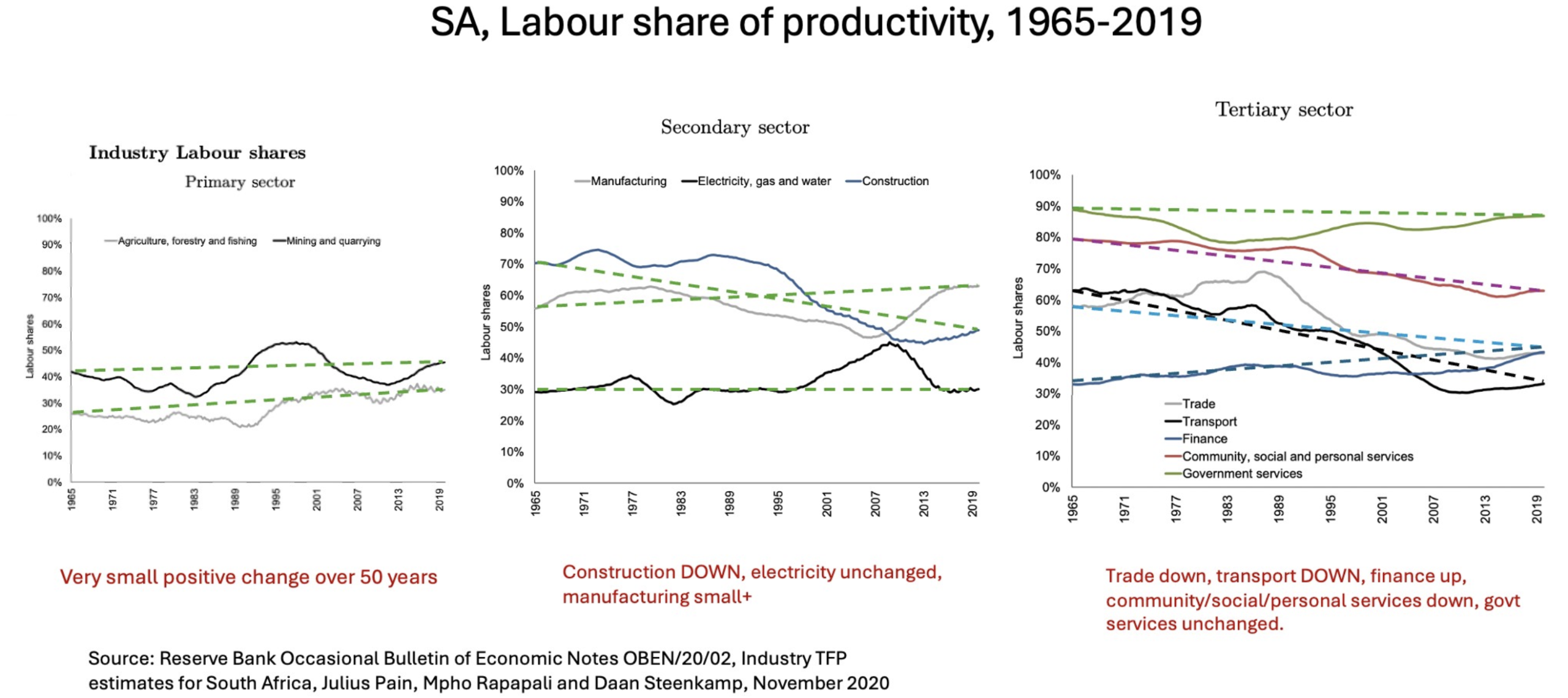
Labour’s share of productivity from 1965 to 2019 shows a very small positive change over fifty years.
While high productivity can be a sign of a competitive enterprise, high productivity is not a guarantee of competitiveness. Many external factors are decisive for competitiveness, for example, tariffs.
How do we think about productivity?
A story from Marikana illustrates both the operational and political challenges associated with productivity bargaining. Platinum prices fall, driving productivity down. Management withdraws a productivity bonus. The move is not well communicated, and workers are upset because they are less able to absorb this ‘loss’ in pay than management. The bonus is probably priced-in for workers before it is paid, especially if there have been prior payouts that lead to a reasonable expectation.
Productivity is significantly down, but not because of any change in the production process, only because the price of the output has fallen on the global market.
How do we think about the politics of productivity?
Bargaining is already hard.
Must a worker take responsibility for productivity measures and outcomes that they are not given the space to influence? Bad management practices might be the real problem, or anything else beyond workers’ control.
A capitalist enterprise will say that it rewards risk, and that is why it pays so differently in different occupational categories. So if workers are not rewarded for risk, how can they be asked to take the risk? A productivity agreement is not a risk reward. It is a reward for meeting productivity targets and is therefore self-financing.
When bargaining, companies are saying that workers have the power to change the fortunes of the company, by moderating their wage demands or raising productivity levels. When they are not bargaining, companies are not saying that workers have the power to change the fortunes of the company. This is the work of executive management. Workers are viewed as a liability.
Workers’ incomes are often significantly lower than those in higher occupational categories. Workers are less resilient to shock than other occupational categories. So-called bonuses are already factored into workers’ livelihoods.
Workers do not like variability in pay. There is little trust in the workplace, and it is therefore hard to navigate a variable payment arrangement based on “facts”. No one believes anyone else.
It may be that genuinely fair productivity bargaining presupposes that a general wellbeing already exists in the population, and sufficient trust to manage uncertainty. South Africa is not Japan and cannot mobilise culture in comparable ways. South Africa is emphatically not the German model of codetermination. Collective bargaining is very stylised in South Africa, a predictable ritual, a ritual that all the actors are complicit in reproducing, and one that leaves almost no room for creativity.
What we can do
Restructuring and retrenchment are the dark side of productivity and competitiveness. How the trade union handles these processes will determine how the union is viewed by workers at large. The framework for dealing with these dynamics is not really about securing better severance pay. It is about saving jobs and companies with them. The hard part is developing enough people with these skills in the union.
Bargaining with evidence means bargaining with data. What data do we have? What data do we need? What data are we able to manage? What data are we able to analyse? The good news is that we have access to more data than we think, and we have the possibility of developing that data. The bad news is that the answers to the other questions are not great.
We can improve our management of the data resources that we do have, starting with collective bargaining agreements and membership data, which we can analyse for strategic insights using data science.
Time: Is there space, time and recognition for preparing and strategising for collective bargaining? A national bargaining conference is important. A process around it even more so. How important are bargaining outcomes to the union?
Know thy company: How are workers’ wages distributed? How many workers are in each of the main job descriptions? What is the average pay and range of pay in each category? An age and gender distribution in each category would be valuable. What information do we have already? Who can we ask for the information we don’t have? I think we can get there. If you have real political will for this, start a conversation with us.
We can acknowledge the difficulty of measuring productivity, and the difficulty of pegging pay to productivity measures. Working out good profit-share arrangements should be our focus. One idea among many: a notch system for productivity-linked payments based on a reasonable forecast for the period. Base pay continues to move with inflation. The structure of the economy and the position of companies in value chains are decisive in matters of productivity. Shifting South Africa’s profile is complex and requires all social partners.
More nuanced approaches to productivity measurement are welcome, and likely will be hard to put into effect. Micro-economic support to companies is welcome. Trade unions should have a framework for dealing with these kinds of interventions. Are SETAs able to deliver on a productivity agenda? Are SETAs delivering on trade union needs? Are trade unions able to mobilise resources in their own right from SETAs?
What could you do, from where you are, to improve the ability of the union to bargain with data, with evidence and a strategy?
Here are some possibilities.
- Work with people to collect information/data
- Help record data
- Help manage data
- Get information from management
- Help analyse data/information
- Hold or facilitate processes and discussions
- Share experiences and stories of negotiating
- Authorise work/projects to develop trade union capabilities.
Presented at the ILO Capacity Development Workshop ‘Productivity Ecosystems for Decent Work’, Johannesburg, October 2025
________________________________________
References:
Pain, J., Rapapali, M. and Steenkamp, D. (November 2020). Industry TFP estimates for South Africa. Reserve Bank Occasional Bulletin of Economic Notes, OBEN/20/02.
Productivity SA (2024).
Labour Research Service. The Negotiator’s Guide, Chapter 9: Negotiating Retrenchment.
Labour Research Service. Collective Bargaining Agreements Database (AGREED).
RELATED ARTICLE
The top ten highest-paid CEOs in South Africa in 2025