
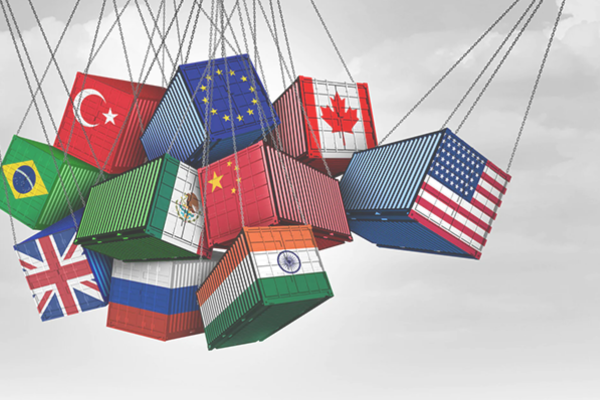
We cannot imagine a modern world without international trade. International trade allows countries to avoid having to produce everything that society needs or desires to consume. International trade provides the opportunity to transcend the limits of the national economy.
The content of trade and the terms of trade are important. Prior to World War II, international trade was little more than piracy, which is to say that there were no rules. Trade was driven by power and opportunity. The rules-based order that emerged after World War II is a significant evolution of international trade.
Even so, the outcomes of international trade are not equally distributed across countries. Africa, for example, remains on the periphery of the global economy, supplying raw materials and low value-add products to the world, while importing much of the higher value-add manufactured goods that it requires. Contemporary history suggests that it is not easy to break out of this cycle.
International trade is a function of geopolitics, the power relations and inter-relations between regions.
The system is not completely static. For example, the rise of the Asian countries exporting higher value-add manufactured goods to the world. China has been industrialising all the while and has become the factory of the world.
The world order and attendant system of international trade is really quite stable in the decades after World War II, even though the Cold War – itself a rules-based system of proxy wars offering an alternative to direct conflict or hot war.
Certainly the last decade shows that this system is unravelling. The rise of China, alongside India and others, not just a manufacturing powerhouse but a superpower in its own right, has shifted the balance of trade and of power.
The US appears unable to grasp the benefits that accrued to it as the world’s only superpower, global police person, guardian of trade routes, global currency and exporter of culture and much else besides.
The US is repositioning itself globally, wanting to be number one without taking on any responsibility. The US has done more to precipitate a crisis at the World Trade Organisation than any other country and is walking away from multilateralism. More recently, the US is resetting all trade arrangements by unilaterally imposing new punitive tariffs on trading partners. While much of this may be performative and subject to change in the near future, it is certainly destabilising production, investment and the relationships that underly production and investment. The effects cannot be reversed by another change in the US tariff regime.
The US administration’s contempt for multilateral institutions is by now well-known and will corrode the ability of the global community to respond to national and international crises, be they global pandemic, natural disasters or military conflict.
The war in Ukraine and in particular, the apathy of the US when confronted by Russian aggression intimates a return to “spheres of influence” geopolitics, where the powerful shape relations in the neck of the woods at the expense of the weak.
Russia’s invasion of Ukraine has already reshaped both energy and agro-processing value chains and trade patterns.
The European Union is unprepared to protect the rules-based system, militarily and politically. The swing to the right in many liberal, economically democracies in Europe predates the shift in American foreign policy under Donald Trump. Variations on the theme of ethno-nationalist populist politics are evident in much of Europe, and they seem very confused about Russia’s actions in the East.
The moral mathematics of the war in Gaza threatens to eat some liberal democracies from the inside, just as it threatens to escalate into an all-out regional conflict.
This deeply divisive conflict is yet another factor frustrating the ability of the so-called West to articulate a coherent account of what it stands for in the world.
The new global information landscape, dominated by social media, appears well-suited to frustrate our efforts to manufacture consensus on just about any issue that matters. The very openness that was the source of dynamism to many societies now renders them most vulnerable to information wars that seek to undermine institutions and fracture public opinion.
China is emerging as a real threat to US hegemony and has been deepening political old economic relations globally for some time now, just as the US appears to be retreating from the global stage to concentrate its efforts on countering China.
If not economically, the political and military withdrawal of the former colonial powers from Africa is almost complete.
It is hard to imagine Africa benefitting from a reconstellation of the global order.
The reconstellation of the global order that is undoubtedly underway will impact international trade and investment in profound ways. It may close certain markets to Africa just as it may open others. Heightened conflict seems inevitable at this point, and this will further politicise trade, breaking and reshaping value chains and trade and investment flows.
It is hard to imagine Africa benefitting from this reconstellation of the global order. You may argue that Africa has very little to lose from such a low station in the global political and economic order. But the argument cuts both ways. Why should Africa gain from any new order in which African states are not primary actors? Why would musical chairs between the most powerful nations transform the productive capacity of African states?
A number of the resources that underpin the new technologies of renewable energy and artificial intelligence sit beneath African soil. Why will the terms of extraction of these resources be any different to the past?
Has our industrial base developed? Has the process of modern state formation advanced? Are we better positioned to shape the terms of engagement with a new global order or disorder?
The new imperative for Africa is the same as the old imperative. We must transform, develop and integrate our economies. We must build regional and continental value chains that provide a basis for developing productive capacity and upgrading that capacity over time. We must overcome the transport and logistic infrastructure deficits that disincentivise intra-African trade. We must confront our denial of the political, social and economic legitimacy of informal cross-border trade and informal economic activity generally. Improved resource rents present possibilities for financing the massive infrastructure investment required to transform the African economy and society.
The coordinated investment required to build regional value chains will require a boldness of vision and level of political leadership that is not immediately apparent on the continent. But this human capital exists along with the material resources necessary to underwrite this project.
The regional economic communities of Africa are an obvious starting point and in some instances the process of integration is relatively advanced. Let us throw our weight behind these communities. After all, it will be easier to unite five than to unite 53. In the absence of strong central states, an ethical trade union movement with an understanding of trade, investment and industrial policy can play an important role in moving us along this path.
As many reasons as there are why the African Continental Free Trade Area (AfCFTA) should fail, there are just as many reasons why it should succeed. The character of the AfCFTA has yet to be determined. The trade union movement in Africa, as the most coherent organisation of civil society on the continent, holds the potential to steer transformation and development.
Meaningful sub-regional and continental value chains offer the best protection we have against a dysfunctional global order tilting into conflict and confusion.
Are we up to the political, intellectual and organisational challenge?