
The language of worker organisation in South Africa has long been dominated by the trade union. To speak of labour struggle is, almost instinctively, to speak of unions, their histories, their victories, their internal fractures, and their enduring political significance. But what happens when workers begin to organise outside of that form? What does it mean when Community Health Workers choose to name themselves not as a union, but as a forum, and in doing so, signal both a departure and a critique?
The emergence of the South African Care Workers Forum is not incidental. It is a response. It reflects a growing dissatisfaction with traditional forms of organised labour, particularly among workers who already occupy precarious, marginal positions within the economy. For Community Health Workers, whose employment status has often been contested and whose working conditions remain unstable, the question is not simply how to organise, but how to do so in a way that reflects their lived realities.
At first glance, the distinction between a union and a forum may appear semantic. But it is, in fact, deeply political. Trade unions in South Africa carry a particular historical weight. They were central to the anti-apartheid struggle, forming part of a broader movement that linked workplace demands to national liberation. In the democratic era, unions have retained significant institutional power. They are recognised within labour law, have established bargaining frameworks, and possess the ability to negotiate collective agreements, engage in protected strikes, and influence policy.
These are not insignificant strengths. They matter precisely because they translate worker organisation into enforceable outcomes. A union, at its best, offers structure, continuity, and access to formal mechanisms of power. It can convert collective grievance into legal and political leverage. For workers seeking stability, recognition, and material gains, this infrastructure is often indispensable. But institutions, by their very nature, also produce distance.
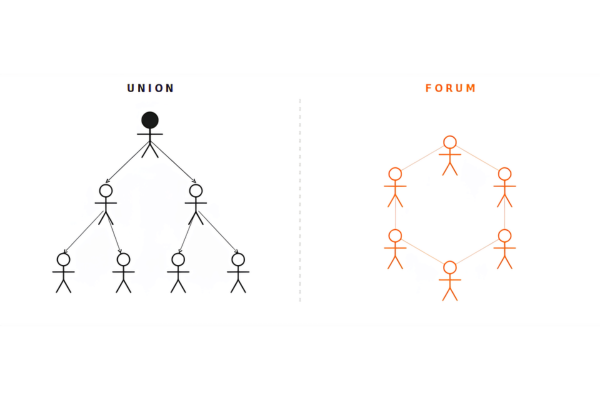
One of the central critiques levelled by Community Health Workers is that union structures can become overly centralised. Decision-making often sits with elected leadership, and while this is a feature of representative democracy, it can create a sense of detachment between members and those who speak on their behalf. The result is a perception, and sometimes a reality, of a top-down approach, where workers are mobilised, but not always meaningfully included in shaping the direction of their struggles.
This critique is not new. It has surfaced repeatedly in labour movements across contexts. What is significant here is how it intersects with the specific conditions of care workers. These are workers who have historically been spoken for rather than listened to, whose labour has been mediated through NGOs, state departments, and intermediaries. To then enter a structure that reproduces even a diluted version of that distance can feel like a continuation of the very marginalisation they are attempting to escape. The forum, in this context, offers an alternative.
As a form of organisation, a forum tends to emphasise participation over representation. It creates space for direct engagement, for collective discussion, and for a more immediate articulation of worker experiences. It is, at least in principle, more fluid, less hierarchical, and more responsive to the needs of its members. For workers who are highly politicised and deeply invested in the direction of their struggle, this can be a powerful model. The South African Care Workers Forum, by naming itself as such, signals an intention to build from the ground up. It reflects a desire for ownership, not only over demands, but over the processes through which those demands are formulated and pursued. It suggests a form of organising that is rooted in lived experience rather than mediated through institutional layers.
This is a significant strength. It allows for a politics that is immediate and accountable, where leadership is not distant but embedded within the collective. It can foster a sense of solidarity that is not only strategic, but relational. And in a sector like care work, where labour is already deeply interpersonal, this mode of organisation may resonate more closely with how workers understand their own roles and responsibilities. But the forum model is not without its limitations.
The absence of formal recognition within labour law is not a minor issue. Without the legal status afforded to unions, forums may struggle to access the very mechanisms that make collective bargaining effective. They may find themselves excluded from formal negotiation spaces, their demands acknowledged but not binding, their capacity to compel change significantly reduced. This raises a difficult question, can a structure that prioritises participation sustain the kind of pressure required to secure material gains?
There is also the challenge of scale. As movements grow, the very qualities that make forums appealing, fluidity, openness, decentralisation, can become difficult to maintain. Decision-making can become slower, consensus harder to reach, and internal disagreements more complex to navigate. Without clear structures, there is a risk that the organisation becomes fragmented or that informal hierarchies emerge in place of formal ones. Unions, for all their flaws, have developed mechanisms to manage these challenges. Their bureaucracies, often criticised, are also what allow them to operate at scale, to engage consistently with employers and the state, and to sustain long-term campaigns.
What we are confronted with, then, is not a simple choice between two models, but a tension between different forms of power. On the one hand, there is institutional power, the kind that comes with legal recognition, established procedures, and access to formal bargaining structures. On the other, there is participatory power, the kind that emerges from collective engagement, from workers speaking in their own voices, and from organising that is deeply rooted in lived experience.
The decision by Community Health Workers to organise as a forum rather than a union is, in many ways, an attempt to reclaim the latter. It is a refusal to enter structures that they perceive as insufficiently responsive, and a commitment to building something that reflects their own political consciousness. But this does not resolve the tension. If anything, it sharpens it. Because the question is not only how workers organise, but how their organisation translates into change. It is one thing to build a collective that is participatory and grounded. It is another to ensure that this collective can effectively confront employers, influence policy, and secure tangible improvements in working conditions.
It is one thing to build a collective that is participatory and grounded. It is another to ensure that this collective can effectively confront employers, influence policy, and secure tangible improvements in working conditions.
Perhaps the task, then, is not to romanticise either form, but to think critically about how they might be reimagined. What would it mean for unions to take seriously the critiques being raised, to deepen member participation, to decentralise decision-making, to become more responsive to the workers they represent? And conversely, what would it mean for forums to develop strategies that allow them to engage with formal systems of power without losing the very qualities that define them?
They are experimenting, challenging, and redefining what organised labour can look like in a context marked by precarity and inequality. This, in itself, is a significant development.
But it also leaves us with a set of unresolved questions about power, representation, and the future of worker organisation in South Africa. Questions that cannot be answered by choosing one model over another, but that demand a deeper engagement with what it means to organise in ways that are both democratic and effective. If the goal is to secure dignity, fair labour practices, and meaningful recognition for care workers, then the form of organisation matters. But so too does its capacity to act.
And so the question that remains is this: in a landscape where workers are seeking both voice and power, what kind of organisation is capable of holding both without sacrificing one for the other?
RELATED ARTICLE
Community Health Workers: “Nothing about us without us”
Essential resource: Thinking about recruitment and organising